Arcana 18 (The Moon)
What The Moon (XVIII) Means in Practice
The Moon is the card of thresholds: the doorway between consciousness and the unconscious, the visible and the invisible, certainty and the soft terrain of dreams. While many Tarot cards describe events or emotional states, The Moon describes atmosphere. It surrounds the querent in a psychological weather pattern — misty, symbolic, disorienting, and profoundly revelatory for those who know how to read its language.
In practical readings, The Moon rarely signals disaster. Instead, it marks a phase where perception is layered, where the surface of a situation conceals deeper currents, and where intuition becomes more reliable than logic. The card asks you to understand the nature of your fears, to interrogate the origins of your intuition, and to become literate in the metaphors that structure your inner world.
To understand how cycles of shadow and illumination connect to your personal archetypal patterns, the Arcana Calculator can reveal your Major Arcana number and its influence on how you experience intuition, dreams, and subconscious material.
For a broader comparison, pair it with The High Priestess and The Hermit to explore related themes and archetypes.
Core Meaning: The Atmosphere Where Truth Hides in Plain Sight
At its center, The Moon represents the liminal space — the in-between where old certainties dissolve and new understanding has not yet crystallized. It is not a card of deception in the conventional sense; it is a card of reflection. What you see under moonlight is shaped as much by your inner landscape as by external reality. The card teaches that perception is never neutral and that your fears, desires, and projections actively sculpt the world you believe you see.
The Moon asks: what are you seeing that is actually a projection? What fears are dressing themselves as intuition? And what truths are hiding in the very confusion you are trying to escape? It does not answer these questions; it creates the conditions under which you can finally ask them with sincerity.
Key themes include: navigating ambiguity, shadow literacy, dream symbolism, intuitive pattern recognition, emotional projection, the dissolution of false certainty, and the courage to move through uncertainty without a map.
Symbolism and Card Imagery
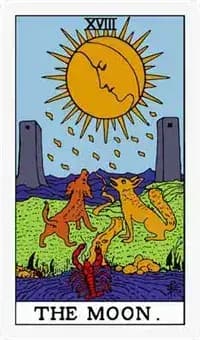
In the Rider-Waite-Smith tradition, The Moon depicts a night scene with a large crescent moon between two towers, a winding path leading into the distance, and two animals — a dog and a wolf — howling at the moon while a crayfish emerges from water. Each element carries precise meaning:
- The Moon Itself: Represents the reflective, non-direct light of intuition and the unconscious. Unlike the Sun, which illuminates directly, the Moon reveals through reflection, shadow, and suggestion. It symbolizes the part of awareness that operates below conscious thought.
- The Two Towers: Mark the boundary between the known and the unknown. They are not obstacles but gateways, representing the threshold the querent must cross to access deeper understanding. What lies between them is neither safe nor predictable — but it is real.
- The Dog and the Wolf: Represent the domesticated and wild aspects of instinct. The dog symbolizes conditioned, socialized responses; the wolf represents primal, untamed intuition. Together they remind us that both aspects must be acknowledged for true self-knowledge.
- The Crayfish Emerging from Water: Symbolizes primitive consciousness and deep emotional material rising to the surface. Like the crayfish, subconscious content often emerges sideways — indirectly, through dreams, body sensations, and emotional triggers rather than clear thoughts.
Together, these symbols frame The Moon as an invitation to develop symbolic literacy: the ability to read the language of the unconscious as it communicates through dreams, emotions, bodily sensations, and repeating patterns.
Psychological Depth: Shadow Literacy and the Unconscious
From a psychological perspective, The Moon aligns with Carl Jung’s concept of the shadow — the aspects of the self that operate outside conscious awareness but still influence behavior, relationships, and perception. Shadow material is not dark in the moral sense; it is dark in the visual sense. It is simply what you have not yet illuminated.
The Moon often appears when unconscious patterns are surfacing: childhood narratives replaying in adult relationships, fears projecting themselves onto neutral situations, or intuitive signals trying to break through the noise of overthinking. Under The Moon, intuition becomes a sophisticated form of pattern recognition rather than a mystical impulse. Dreams sharpen. Synchronicities increase. Emotional reactions intensify.
The work of this card is interpretive, not declarative. You are not asked to feel your way through in the vague sense; you are asked to translate symbolic data into insight. The discomfort or confusion you feel is not a sign of failure but a sign that something important is emerging from beneath the surface.
Upright Meaning of The Moon
When The Moon appears upright, it typically signals one or more of the following experiences:
- A period of ambiguity where the facts are unclear but your intuitive sense of direction remains strong — if you listen carefully.
- Shadow material surfacing: old fears, forgotten memories, or inherited emotional patterns becoming visible in your reactions and relationships.
- A creative or spiritual incubation phase where ideas are gestating below the surface and premature conclusions would interrupt the process.
- The need to distinguish between genuine intuition and fear-driven projection — a skill that develops only through patient self-observation.
The immediate feeling is disorienting but not threatening. The Moon upright asks you to trust the process of not-knowing, to collect symbolic data without forcing conclusions, and to recognize that some truths reveal themselves only in twilight.
Reversed Meaning: When the Inner Night Becomes Distorted
Reversed, The Moon indicates that ambiguity has tipped into confusion and that emotional signals are being misread. Anxiety may be projected outward, transforming internal uncertainty into external paranoia. What was once productive uncertainty becomes paralyzing doubt.
- Difficulty distinguishing between genuine intuitive insight and fear-driven narrative — often resulting in suspicion of people or situations that do not warrant it.
- Emotional overwhelm caused by unprocessed subconscious material flooding conscious awareness without the tools to interpret it.
- A warning that avoidance of shadow work has created a backlog of unexamined fears that now distort perception and decision-making.
The antidote is not to force clarity but to introduce grounding practices that restore perspective: evidence-based reflection, asking trustworthy people for reality-checks, or returning to small routines that anchor the mind. The reversed Moon asks you to slow down, recalibrate, and learn to distinguish fear-driven narratives from genuinely intuitive insight.
Reading The Moon in Real-Life Contexts
Love and Relationships
Upright: A phase of emotional complexity where partners may be reacting to old wounds rather than present realities. Conversations carry subtext. Silence carries weight. Intimacy requires the willingness to sit with uncertainty and to separate intuition from fear, memory from projection. If embraced with curiosity, this phase can deepen bonds by revealing unconscious needs that, once witnessed, become pathways to greater truth.
Reversed: Projection and anxiety creating imagined narratives that feel real. One or both partners may be suspicious without cause, confusing past betrayal with present loyalty. The medicine is direct communication paired with individual grounding — not interrogation of the other, but examination of the self.
Career and Work
Upright: A period of professional transition when the old identity is dissolving and the new one has not fully emerged. Creative projects may feel directionless, not because they are failing but because they are incubating. This phase rewards patience and iterative experimentation. What emerges is often more original precisely because it was allowed to gestate without rigid expectation.
Reversed: Confusion about professional direction, possibly fueled by unexamined fears of inadequacy or impostor syndrome. Decisions made from this state often backfire because they are reactions to internal anxiety rather than responses to external reality. The advice: pause major decisions until grounding returns.
Personal Growth
Upright: A powerful phase of shadow integration where unconscious patterns are becoming visible and can finally be worked with consciously. Dreams, journaling, therapy, or meditation may yield unexpected insights. The key is to observe without judgment — to let the material show itself before attempting to fix it.
Reversed: Resistance to looking inward, often manifesting as distraction, numbing, or obsessive analysis of external situations. The reversed Moon suggests that the avoidance itself has become the problem — and that gentle, structured engagement with the shadow is the only way through.
A Reliable Way to Read The Moon
To keep interpretations grounded and constructive, use this four-step approach:
- Name the Atmosphere: Describe the emotional tone of the situation in three words — not events, but texture. This reveals what The Moon is reflecting.
- Locate the Projection: Ask: what am I reacting to that may not be objectively present? Where might past experience be coloring current perception?
- Collect Symbolic Data: Notice dreams, bodily sensations, recurring themes, and emotional triggers over the next several days. Write them down without immediate interpretation.
- Distinguish Fear from Intuition: Genuine intuition tends to feel steady and calm even when the message is difficult. Fear feels urgent, scattered, and demanding. Practice telling the difference.
This method honors The Moon’s deeper teaching: clarity is not something you force in darkness. It is something that emerges when you learn to see by a different light.
Boundaries and Responsible Use
Tarot is a reflective instrument, not a substitute for emergency services, mental health support, or legal counsel. Use The Moon to deepen self-awareness and decision quality, while relying on qualified professionals when life circumstances are acute — especially if readings trigger anxiety, paranoia, or emotional flooding.
If a reading triggers overwhelm, prioritize grounding first. Return to basic self-care, delay major decisions if possible, and seek professional support when needed. The goal of reading The Moon is gentle clarity and symbolic insight, not the reinforcement of fear-based narratives.
The Moon in the Fool’s Journey
In the Major Arcana sequence, The Moon follows The Star (XVII) and precedes The Sun (XIX). This placement is deeply meaningful: after the restoration of hope and inner light comes the confrontation with the deeper unconscious material that hope alone cannot resolve — and after that confrontation comes the clarity and joy of authentic illumination.
The Moon is the depth-work phase of the Fool’s Journey. It is the moment when the traveler must leave the comfort of starlight and enter the terrain where old stories dissolve and new ones have not yet formed. What follows is not merely survival — it is the integration of shadow and light that makes genuine happiness possible.
Within this arc, The Moon serves as the guardian of the threshold. It does not block the path; it simply insists that those who pass through must be willing to see themselves honestly — including the parts they have spent a lifetime avoiding.
Reflection Prompt and Closing
A practical reflection question for this card is:
"What am I most afraid to see — and what might become possible if I saw it?"
The Moon teaches that spiritual maturity develops not through certainty but through your capacity to navigate the unlit parts of your own psyche. It insists that some of the most important transformations happen in twilight, not daylight, and that the ability to move gracefully through uncertainty may be the highest form of wisdom.
In the Tarot’s grand narrative, The Moon is the necessary darkness that makes The Sun meaningful. Understood deeply, it reminds us that the shadows we fear are often portals — and that the courage to look at what hides within them is the same courage that eventually leads us home to ourselves.
Continue the Tarot Journey
Related Tarot Cards
Ready to Calculate Your Arcana?
Use Arcana Calculator to find your Major Arcana tarot card by birth date and name. Get personalized numerology insights and spiritual guidance. Calculate yours now!
Calculate Now