Arcana 11 (Justice)
What Justice (XI) Means in Practice
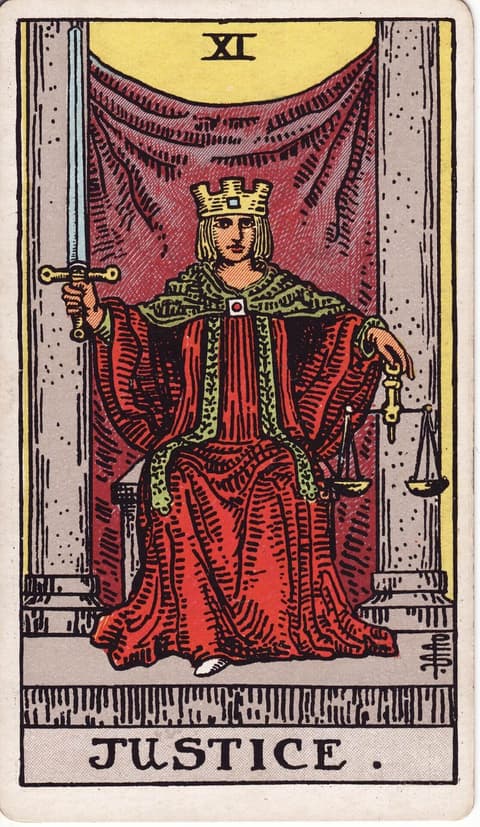
Justice is the tarot card of truth, consequence, ethical clarity, and balance. It asks you to weigh facts carefully, act with integrity, and understand that every choice creates a result. Where other cards explore emotion, desire, or spiritual awakening, Justice demands something rarer: intellectual honesty and the courage to live by it.
In most modern decks, Arcana 11 refers to Justice, even though some historical traditions switch the numbering of Justice and Strength. In readings, this card often appears when fairness, decisions, contracts, accountability, or karmic cause and effect are in focus. It does not promise comfort; it promises clarity.
To understand how themes of truth and accountability connect to your personal archetypal patterns, the Arcana Calculator can reveal your Major Arcana number and its influence on how you experience balance, integrity, and the natural law of cause and effect in your life.
For a broader comparison, pair it with The Emperor and Strength to explore related themes and archetypes.
Justice as Your Personal Arcana
If Justice is your personal Arcana, truth, accountability, and the need for fair choices may shape how you move through life. You may naturally look for the facts, notice inconsistencies, and want decisions to match your values.
The lesson is not to become the judge of everyone around you. It is to balance clear standards with self-compassion, then act with integrity even when the outcome is inconvenient. Calculate your birth-date Arcana to explore how Justice may shape your personal pattern.
Calculate your Personal ArcanaCore Meaning: The Architecture of Consequence
At its center, Justice represents the principle that reality is organized by truth whether or not we welcome it. It is not a card of punishment or reward in the moralistic sense; it is a card of alignment. When your actions, words, and values are in harmony, Justice feels like quiet confirmation. When they are not, it feels like the moment before a necessary correction.
Justice asks: where in your life are you negotiating with a truth you already know? What agreements — with others or with yourself — are no longer sustainable? And what would it cost to restore alignment, compared to what it costs to maintain the imbalance?
Key themes include: truth as a structuring force, accountability without blame, ethical decision-making, karmic cause and effect, the discipline of fairness, and the courage to act with integrity when it is uncomfortable.
Symbolism and Card Imagery
In the Rider-Waite-Smith tradition, Justice is shown seated between pillars, holding scales in one hand and an upright sword in the other. The image is calm, direct, and unsentimental. It does not flatter desire; it clarifies what is true and what must be faced.
Key symbols commonly associated with Justice include:
- The Scales: Represent balance, evidence, reciprocity, and the need to weigh all sides before reaching a conclusion. They remind us that justice is a process of measurement, not assumption.
- The Upright Sword: Points to discernment, truth, and the clean edge of a decision that cannot be postponed forever. The double-edged blade cuts both ways — it separates truth from falsehood, but it also demands that the wielder be equally subject to its standard.
- The Stone Throne: Suggests structure, law, stability, and the impersonal framework within which consequences unfold. Justice does not sit on a cushion; it sits on stone — immovable, enduring, and indifferent to personal preference.
- The Pillars: Indicate order, boundaries, and the idea that justice operates within principles rather than moods. They frame the space of judgment as a sanctuary of reason, protected from the chaos of unexamined emotion.
- The Crown and Robes: Reflect authority, responsibility, and the moral seriousness required to judge fairly. They remind us that justice is not casual — it is a sacred responsibility that demands maturity and impartiality.
Taken together, these symbols frame Justice as a card of clarity, responsibility, and alignment between action and truth. The figure is not angry, not punitive, not sentimental — simply committed to what is real.
Psychological Depth: Cognitive Dissonance and the Integrity Gap
From a psychological perspective, Justice aligns with the concept of cognitive dissonance — the tension that arises when our beliefs, values, and actions are in conflict. When this tension becomes too great, the psyche demands resolution: either we change our behavior, or we distort our perception of reality to protect our self-image.
Justice often appears when this tension has reached a threshold. It may manifest as the inability to sleep after a dishonest conversation, the growing resentment in an unbalanced relationship, or the quiet knowledge that a professional compromise has become a pattern. The discomfort is not random; it is the psyche's alarm system signaling that alignment is needed.
The work of this card is not self-punishment but self-correction. It asks you to close the integrity gap — the distance between who you claim to be and how you actually behave — with honesty rather than harshness. The goal is not perfection; it is coherence.
Upright Meaning of Justice
When Justice appears upright, it typically signals one or more of the following experiences:
- Truth and Clarity: Facts matter now. The situation improves when you look directly at what is real instead of what is comfortable. Evidence, documentation, or honest conversation becomes essential.
- Accountability: You may need to own your choices, accept consequences, or ask others to do the same. Justice upright does not assign blame; it assigns responsibility.
- Fair Decisions: A balanced judgment, contract, negotiation, or ethical choice is central to the moment. The best decision is the one that is fairest to all involved, including yourself.
- Integrity: Justice rewards alignment between your values, words, and actions rather than emotional avoidance. It is the card of walking your talk, even when no one is watching.
In readings, upright Justice can indicate legal matters, formal agreements, honest evaluation, or a turning point where fairness and personal responsibility matter more than impulse. It is the card of doing what is right because it is right, not because it is easy.
Reversed Meaning: Imbalance and the Cost of Avoidance
Reversed, Justice often highlights imbalance or avoidance. The natural law of cause and effect has not been suspended; it has simply been ignored — and the interest on that debt is accumulating.
- Unfairness: Bias, unequal treatment, or one-sided narratives may be distorting the situation. Someone may be receiving credit they did not earn, or blame they do not deserve.
- Avoiding Consequences: Someone may be deflecting responsibility, rationalizing behavior, or refusing to face the truth. The reversal asks whether that avoidance is sustainable — and for how long.
- Confusion and Delay: The facts may be clouded, or a needed decision may be postponed because it feels uncomfortable. Justice reversed warns that delay is not neutrality; it is a choice with its own consequences.
- Ethical Misalignment: A choice, agreement, or relationship may no longer be aligned with honesty, law, or deeper values. The reversal is an invitation to examine where compromise has become corruption.
In this position, Justice asks whether the real issue is external unfairness or an internal refusal to be fully truthful. The answer is often both — and both must be addressed for balance to return.
Reading Justice in Real-Life Contexts
Love and Relationships
Upright: Justice upright can show honesty, clear boundaries, mutual accountability, and a relationship that grows stronger through truth rather than performance. It may indicate a need for a difficult but necessary conversation, or a renegotiation of terms that restores fairness.
Reversed: Reversed, it may point to blame, imbalance, hidden resentment, broken promises, or the feeling that one person is carrying more than the other. The medicine is not accusation but accountability — beginning with an honest look at your own contribution to the dynamic.
Career and Business
Upright: This card can indicate contracts, negotiations, HR or legal themes, ethical decisions, and professional situations where accuracy and fairness are essential. It supports decisions made on evidence rather than office politics or personal favor.
Reversed: Reversed, it may suggest office politics, misleading information, unfair treatment, or a decision made without full transparency. Justice reversed in career readings often signals that the formal structures are not functioning as they should — and that documentation or external perspective may be needed.
Personal Growth
Upright: Justice supports self-honesty, clean decision-making, and the maturity to see cause and effect in your own life. It is the card of taking inventory: where have you been consistent, and where have you been convenient?
Reversed: Reversed, it can reveal self-justification, denial, harsh self-judgment, or the need to stop confusing avoidance with peace. The reversal asks you to examine whether your standards for yourself are as rigorous as your standards for others — or whether you have inverted the two.
How to Work with Justice in Readings
To connect more deeply with Justice, try the following practices:
- Meditation: Visualize a set of scales becoming balanced and ask what truth needs to be acknowledged for real equilibrium to return. Do not force the answer; let it arrive.
- Journaling: Write about a recent decision and separate the facts, feelings, assumptions, and responsibilities involved. Notice where emotion is masquerading as logic — and where logic is masquerading as avoidance.
- Affirmations: Use phrases like I face the truth with steadiness and I choose fairness, clarity, and integrity. Repeat them until they feel like descriptions rather than aspirations.
- Decision Practice: When you reach a crossroads, ask what option is most honest, sustainable, and aligned with your values over time. Then ask what you are afraid that answer will cost you.
Boundaries and Responsible Use
Tarot is a reflective instrument, not a substitute for legal counsel, mental health support, or emergency services. Use Justice to deepen self-awareness and decision quality, while relying on qualified professionals when life circumstances involve legal, financial, or psychological complexity.
If a reading triggers guilt, shame, or overwhelm, prioritize grounding first. Return to basic self-care, delay major decisions if possible, and seek professional support when needed. The goal of reading Justice is clarity and constructive alignment, not self-punishment or moral condemnation.
Spiritual Significance of Justice
Spiritually, Justice reflects karmic balance, moral alignment, and the principle that truth organizes reality whether or not we welcome it. It is a card of cause and effect, but also of conscious correction. The universe does not punish; it aligns. And Justice is the moment we choose to participate in that alignment rather than resist it.
Justice teaches that balance is not passivity. It requires courage, accountability, and the willingness to bring your inner standards and outer actions into the same line. The spiritual work of this card is not about becoming perfect; it is about becoming whole — undivided between what you believe and how you live.
Justice in the Fool's Journey
In the Major Arcana sequence, Justice follows The Wheel of Fortune (X) and precedes The Hanged Man (XII). This placement is deeply meaningful: after the lessons of fate, cycles, and change comes the demand for conscious accountability — the understanding that we are not merely subjects of fortune but active participants in creating our outcomes.
Justice is the maturity checkpoint of the Fool's Journey. It is the moment when the traveler can no longer blame circumstance, luck, or others for the state of their life. What follows is not merely harder — it is more honest. And honesty, once established, becomes the foundation for everything that comes after.
Within this arc, Justice serves as the architect of integrity. It does not remove difficulty; it removes self-deception. What remains — a life built on truth rather than convenience — is the only foundation strong enough to support genuine transformation.
Final Reflection: The Quiet Weight of Truth
A practical reflection question for this card is:
"What would integrity look like here if I were completely honest — with myself first?"
- Where in my life do I already know the truth, but still hesitate to act on it?
- What consequence, conversation, or correction am I trying to postpone?
- How can I practice fairness without abandoning compassion or self-respect?
Conclusion
Justice asks you to stop negotiating with what you already know. It is the card of truth, fair consequence, and the discipline to choose what is right even when it is uncomfortable. It does not demand perfection; it demands honesty. And honesty, practiced consistently, becomes the architecture of a life that can be trusted.
In the Tarot's grand narrative, Justice is the moment the Fool becomes accountable — not to an external judge, but to the internal compass that has been pointing toward truth all along. When this card appears, the only real question is whether you are ready to listen.
Continue the Tarot Journey
Related Tarot Cards
Ready to Calculate Your Arcana?
Use Arcana Calculator to find your Major Arcana tarot card by birth date and name. Get personalized numerology insights and spiritual guidance. Calculate yours now!
Calculate Now