๐ŸƒGenerate Your Tarot Card

Upload a photo or describe your vision โ€” 1 Arcana Destiny Reading per generation

๐Ÿƒ

Your generated tarot card will appear here

โœจ Real results โ€” tap to compare

โœจ New users receive 1 free Spark ยท Each generation costs 1 Arcana Destiny Readings

AI Tarot Card Generator

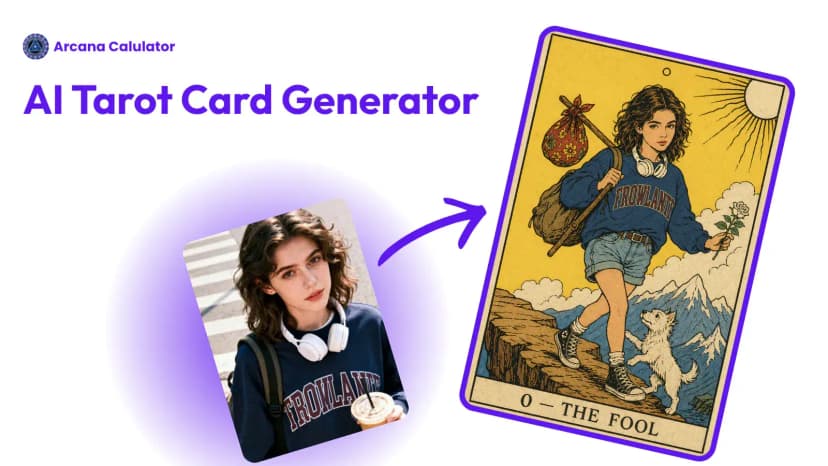
Turn your photo into a personalized tarot card that actually feels like you. This AI Tarot Card Generator lets you create tarot-style portraits, custom Major Arcana characters, and symbolic card art online. Upload a photo, choose a direction, and generate a result that feels mystical, personal, and visually rich.

Tarot imagery has always had a strange pull. Even people who do not read tarot seriously are drawn to the symbols, the archetypes, the atmosphere, and the feeling that a single card can somehow say a lot without explaining itself. That is what makes this kind of tool fun. You are not just making "AI art." You are turning a face, a mood, or a moment into something that looks like it belongs inside a deck.

AI Tarot Card Generator

Free AI Tarot Card Generator Online

A lot of people love tarot visuals but would never sit down and illustrate a card from scratch. The border alone is a project. Then there is the symbolism, the composition, the costume, the lighting, the color story. A good tarot image looks effortless, but usually it is not. That is why a free AI Tarot Card Generator online makes sense. It gives people a way to start from a simple idea and end up with something atmospheric and polished without needing drawing skills, design software, or hours of trial and error. You can come in with a portrait, a vibe, or a specific archetype in mind, and leave with an image that feels intentional rather than random.

โœจ

Create tarot cards instantly in your browser

You should not need a complicated setup just to experiment with tarot-style visuals. One of the best things about an online generator is that it lowers the barrier. You can test different looks, compare versions, and adjust your direction quickly instead of treating every attempt like a major production.
Instant creation
๐ŸŽจ

Generate custom tarot art with no design skills

Not everyone using this page is a designer, and that is exactly the point. Some people want a custom card for fun. Some want a striking social image. Some are just curious what they would look like as The Star or The High Priestess. The tool should work for all of them, not only for people who already know how to build visual compositions from scratch.
No skills needed
๐Ÿƒ

Use it free for personal tarot-style creations

For most users, the first step is simply trying it. They want to see what style feels right, how much of their face is preserved, and whether the result lands closer to "cheap filter" or "actual tarot-inspired art." A free starting point makes that kind of exploration easy and low-pressure.
Free access

Turn Your Photo Into a Personalized Tarot Card

This is where the page becomes more interesting. Plenty of AI image tools can generate fantasy art. Fewer can take a real person and turn them into a tarot-style figure in a way that still feels specific, recognizable, and personal. That distinction matters. The appeal is not just getting a pretty frame and some moon symbols around your head. It is seeing yourself transformed into something more mythic without disappearing inside the process. A good personalized tarot card should still feel connected to the person in the original photo, even as it reimagines them through costume, symbolism, mood, and card identity.

๐Ÿ“ธ

Upload a portrait and generate a tarot-style image

A clean portrait gives the generator a strong place to begin. Once the image is uploaded, the tool can reinterpret it through the visual language of tarot: ornate framing, dramatic atmosphere, symbolic objects, layered backgrounds, and archetypal styling. The best results usually come from photos where the face is clear and the expression is readable.
Photo upload
๐Ÿ‘๏ธ

Keep your facial features while changing the visual style

This is one of the biggest things users care about, even if they do not always say it directly. They want the card to look elevated, but they still want it to look like them. When the face drifts too far, the result stops feeling personal and starts feeling generic. A strong tarot portrait keeps the person recognizable while changing everything around them: palette, costume, setting, lighting, and symbolic context.
Face preservation
๐ŸŒ™

Create a tarot card that feels personal and symbolic

The strongest results are not only visually impressive. They also feel right. Someone drawn to calm, intuition, and mystery may connect with a High Priestess style. Someone in a season of reinvention may prefer The Fool. Someone who wants a more radiant, visible, heart-open energy may lean toward The Star or The Sun. Once users begin thinking this way, the experience becomes deeper than "make me look cool." It becomes a form of self-projection.
Personal symbolism

Make Major Arcana Characters With AI

For most people, the Major Arcana is where the real fascination begins. These are not just cards. They are roles, thresholds, warnings, hopes, mirrors. Even people who are not deeply into tarot tend to recognize the emotional charge of cards like The Fool, The Magician, The High Priestess, The Lovers, Death, or The Star.

๐ŸŽญ

Transform into The Fool, The Magician, or The High Priestess

These cards are especially compelling because they map so easily onto human moods and self-images. The Fool feels open, spontaneous, and full of possibility. The Magician feels focused, self-directed, and capable. The High Priestess feels quiet, perceptive, and deeply inward. Users often connect with one of these right away because the archetype already says something about how they want to see themselves.
Archetype selection
๐Ÿ”ฎ

Match your mood, identity, or archetype to a tarot card

Not everyone arrives knowing which card they want. Some people only know how they feel. They are starting over. They want to feel stronger. They are moving through grief. They are more visible lately. They want softness, mystery, clarity, or confidence. When the page helps translate those states into card identities, the generation becomes more emotionally meaningful.
Mood matching
โญ

Create character-like tarot portraits with symbolic details

A tarot portrait becomes much more believable when the symbolism supports the role. A lantern changes the mood. So does a crescent moon, a throne, a rose, a lion, a scroll, a cup, a star-filled sky, or twin pillars in the background. Those details help the image read like a card rather than just a dressed-up portrait.
Symbolic details

AI Tarot Card Maker for Custom Deck Ideas

Not everyone stops at one card. Once users realize they can generate something beautiful and surprisingly coherent, many of them start thinking bigger. What would a whole set look like? What if each friend in a group had a card? What if a creator wanted to build a themed deck? What if a tarot reader wanted to prototype an alternate visual system for familiar archetypes? That is where the page starts working not just as an image toy, but as a tarot card maker in a more serious sense. It becomes a creative tool for building ideas, not only outputs.

๐ŸŽด

Design a single card or build a full tarot deck

A good generator should feel satisfying whether the user wants one striking portrait or a larger body of work. Some people only want a single image they can save or share. Others want enough consistency to begin exploring multi-card sets. Supporting both use cases makes the page feel much more useful.
Single or full deck
๐ŸŒธ

Use AI to explore symbols, titles, and card concepts

Sometimes the user already knows exactly what they want. More often, they do not. They may have a mood, a phrase, or a half-formed concept. AI is helpful here not because it magically invents meaning, but because it helps turn loose ideas into visible forms quickly. That can be enough to unlock a whole direction.
Concept exploration
๐Ÿช„

Create original tarot cards for art, gifts, or inspiration

Custom tarot imagery works in more situations than people first expect. It can be a gift, a keepsake, a personal ritual object, a visual reference for a story, a social post, a moodboard piece, or simply something beautiful that feels unusually specific to the person who generated it. That mix of personal and visual value is part of why the format works so well.
Creative uses

How to Use the AI Tarot Card Generator

The best experience here is usually simple. People do not need a long tutorial. They need a clear path, a few good choices, and enough guidance to avoid weak inputs. Once that is in place, the process feels intuitive.

Step 1: Upload your photo or describe your tarot card idea

If you want a personalized tarot card, start with a clear photo. If you are going for something more conceptual, begin with a concise description. Either way, stronger input usually leads to stronger output. A little clarity goes a long way.

Step 2: Choose a tarot style, theme, or archetype

This is where users shape the personality of the image. They can choose a specific card, a visual mood, or a broader style direction. Traditional, gothic, celestial, ornate, soft, dramatic, romantic, surreal, cinematic โ€” these choices affect the emotional read of the final result more than many users expect.

Step 3: Generate, refine, and download your result

The first image is often a starting point, not the finish line. Small adjustments can make a big difference: a stronger archetype, cleaner framing, better face preservation, more readable symbols, or a more cohesive palette. The final image usually emerges through one or two thoughtful refinements rather than a single lucky click.

Best Prompts for AI Tarot Card Generation

A lot of weak AI tarot images fail for the same reason: the prompt sounds decorative rather than intentional. It asks for "mystical" without saying what kind of card, what symbolic role, what mood, or what visual structure the image should have. Tarot art gets much stronger when the prompt gives the model a clearer frame.

๐Ÿ’ซ

Prompts for personalized tarot portraits

A useful personalized prompt should combine identity and symbolism. For example: "Turn this portrait into a personalized tarot card, ornate border, celestial background, symbolic lighting, elegant costume, mystical atmosphere, recognizable face, high-detail tarot illustration." This works because it asks for both likeness and card language.
Portrait prompts
๐ŸŒŸ

Prompts for Major Arcana style cards

When the goal is a known archetype, naming it helps. For example: "Create a personalized High Priestess tarot card portrait with moon symbolism, twin pillars, silver and indigo tones, sacred scroll, mysterious and calm expression, detailed tarot frame." The clearer the role, the easier it is for the image to feel like a real card instead of generic fantasy art.
Arcana prompts
๐Ÿฆ

Prompts for custom tarot deck creation

If the user wants a broader deck idea, consistency matters more than intensity. For example: "Design a custom tarot deck in dark celestial style with cohesive ornate borders, symbolic compositions, soft glowing details, consistent visual language across multiple cards." That kind of direction helps the generator think in systems, not just one-offs.
Deck prompts

What Makes a Good AI Tarot Card

Not every visually nice result feels like a tarot card. Some images are attractive but empty. Others are busy but unreadable. A strong card does not need to be overly literal, but it should feel composed with intention.

๐ŸŒˆ

Strong symbols, composition, and visual balance

A viewer should be able to sense what matters in the image. The central figure needs presence. The symbolism should support the card rather than clutter it. And the composition should guide the eye naturally, so the image feels like a designed object instead of a pile of mystical elements.
Visual composition
๐Ÿ›๏ธ

A clear card identity and readable archetype

The strongest cards suggest a role or a state of being. They feel like something. Even if the viewer does not know every formal tarot reference, they should still sense whether the image communicates hope, authority, transition, mystery, vitality, grief, balance, or surrender.
Card identity
๐ŸŽญ

Consistent style across multiple generated cards

This becomes especially important when users want more than one card. A single strong image is nice. A set that feels visually related is much harder to achieve and much more rewarding. Consistency in borders, color treatment, mood, and symbolic logic is what turns isolated outputs into a believable deck direction.
Style consistency

Who This AI Tarot Card Generator Is Designed For

Not everyone lands on a page like this for the same reason, and that is part of its appeal. The same tool can feel playful to one person, expressive to another, and creatively useful to someone else.

๐ŸŽจ

Creators making tarot-inspired art

Some users are here because tarot imagery is simply a rich visual language. They want to experiment with archetypes, aesthetics, and symbolic storytelling. For them, the tool is a fast way to test visual ideas without overcommitting too early.
Art creators
๐Ÿ”ฎ

Tarot readers exploring visual deck ideas

Others are already familiar with tarot and want a more personal or experimental way to interact with its symbols. They may not be replacing traditional decks at all. They are exploring alternate ways to imagine them.
Tarot readers
โœจ

Users who want a personalized tarot portrait

This is probably the most immediate audience. They want to see themselves transformed into something beautiful, archetypal, and a little uncanny in the best way. They may not come in thinking about deck theory or symbolism systems. They just know the image format speaks to them.
Personal use

What Users Say About the AI Tarot Card Generator

Here is how different people are using this tool to create meaningful tarot imagery.

Mia C.

Mia C.

Digital Artist

โ€œI used it to create a High Priestess portrait for a project. The symbolism came through clearly and the framing looked genuinely like a tarot card. Saved me hours.โ€

Lena R.

Lena R.

Tarot Reader

โ€œI was skeptical at first but the results were surprisingly personal. I could see my face in the card while still feeling like it had been reimagined into something archetypal.โ€

Jordan K.

Jordan K.

Creative Director

โ€œWe used it for a themed photo project where each person in the team became a Major Arcana card. The consistency across multiple generations was impressive.โ€

Sophie T.

Sophie T.

Content Creator

โ€œIt is the kind of tool that feels like it was made for social media storytelling. The visual output has that perfect mix of personal and mystical that performs really well.โ€

Mia C.

Mia C.

Digital Artist

โ€œI used it to create a High Priestess portrait for a project. The symbolism came through clearly and the framing looked genuinely like a tarot card. Saved me hours.โ€

Lena R.

Lena R.

Tarot Reader

โ€œI was skeptical at first but the results were surprisingly personal. I could see my face in the card while still feeling like it had been reimagined into something archetypal.โ€

Jordan K.

Jordan K.

Creative Director

โ€œWe used it for a themed photo project where each person in the team became a Major Arcana card. The consistency across multiple generations was impressive.โ€

Sophie T.

Sophie T.

Content Creator

โ€œIt is the kind of tool that feels like it was made for social media storytelling. The visual output has that perfect mix of personal and mystical that performs really well.โ€

FAQ About AI Tarot Card Generator

Create Your Personalized Tarot Card Now

Upload a photo, choose the archetype that fits your mood, and see what happens when portrait, symbolism, and tarot aesthetics come together in one image. Whether you want a mystical self-portrait, a Major Arcana transformation, or the beginning of a custom deck idea, this AI Tarot Card Generator gives you a simple way to create something that feels personal.

Generate Your Tarot Card