Minor Arcana 28: Seven of Cups - illusion, fantasy, choice and emotional projection
Introduction to Minor Arcana 28
Minor Arcana 28, the Seven of Cups, is one of tarot’s clearest cards for illusion, emotional projection, and the difficulty of choosing well when everything looks appealing.
It often appears when desire multiplies faster than clarity. Instead of responding to what is actually here, the mind fills the future with promises, symbols, and imagined outcomes.
At its best, this card helps you notice fantasy before it hardens into self-deception. At its hardest, it warns that too many emotionally charged options can scatter your energy and weaken judgment.
For a broader comparison, pair it with Six of Cups and Eight of Cups to explore related themes and archetypes.
Historical context and reading framework
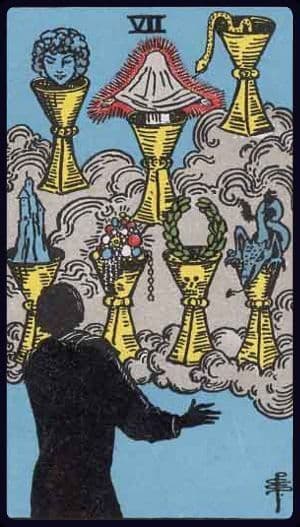
In the Rider-Waite-Smith tradition, the Seven of Cups shows a figure facing seven cups suspended in clouds, each holding a different image or temptation. The scene suggests desire, imagination, seduction, fear, and the mind’s power to invent meaning before anything is tested.
As seven within the suit of Cups, this card often marks expansion without order. A grounded modern reading sees it as fantasy, overchoice, projection, and the need for discernment rather than as a simple promise that every option is real.
Symbolism of the Seven of Cups
The Seven of Cups is visually rich because it is psychologically rich. Its symbols describe what happens when feeling becomes fascinated by possibility but loses contact with proportion.
Key symbols commonly associated with this card include:
- The floating cups: Multiple emotional options, imagined futures, and the sense that too many possibilities are competing for attention.
- The clouds: Ambiguity, dream logic, projection, and the difficulty of seeing clearly when desire is not grounded.
- The figure below: A person confronted by choice, temptation, and the burden of deciding without enough inner hierarchy.
- The different objects in the cups: Pleasure, status, mystery, fear, power, longing, and illusion appearing side by side, each asking to be believed.
- The distance from person to cups: The gap between fantasy and embodiment; these options are emotionally vivid but not yet lived, tested, or integrated.
Taken together, these symbols show that the Seven of Cups is not simply about having choices. It is about the difficulty of knowing which desires deserve reality.
Upright meaning of Minor Arcana 28
When the Seven of Cups appears upright, it often emphasizes:
- Illusion and temptation: Attractive possibilities may be emotionally compelling without being stable, honest, or realistic.
- Too many options: Decision-making becomes harder because desire is scattered across multiple paths at once.
- Projection and idealization: Longing can become so strong that imagined outcomes are mistaken for grounded truth.
- Discernment is needed: The card asks you to slow down, test your motives, and separate real opportunity from emotional mirage.
In practice, upright Seven of Cups does not say that every option is false. It says clarity must come before commitment, otherwise fantasy will choose for you.
Reversed meaning of Minor Arcana 28
Reversed, the Seven of Cups often points to a changing relationship with confusion, fantasy, and choice:
- Seeing through illusion: You may be starting to recognize what is real, what is inflated, and what never had substance.
- Lingering overwhelm: In some readings, the reversal shows that confusion is still active, but now it feels tiring rather than exciting.
- Fantasy collapsing: An idealized story, person, or plan may be losing its emotional hold as reality becomes harder to avoid.
- Refocusing on what matters: The card can also signal simplification, grounded priorities, and the return of better judgment.
In this position, the Seven of Cups asks whether clarity is truly returning or whether you are still hiding inside possibility to avoid choosing.
The Seven of Cups in real-life contexts
1. Love and relationships
Upright: Upright, this card can point to mixed signals, romantic idealization, emotional projection, or being drawn to possibility more than to an actual person or relationship.
Reversed: Reversed, it can suggest seeing a connection more clearly, ending unrealistic expectations, or noticing that confusion has replaced genuine intimacy.
2. Career and work
Upright: In work contexts, the Seven of Cups can indicate too many ideas, seductive opportunities, unclear direction, or the temptation to chase image instead of substance.
Reversed: Reversed, it may show narrowing your focus, abandoning unrealistic paths, or finally choosing a direction that matches your actual capacity and values.
3. Personal growth
Upright: For personal growth, this card highlights the difference between imagination and escapism. It asks you to notice where hope inspires action and where fantasy replaces it.
Reversed: Reversed, it can mark the beginning of emotional sobriety: fewer illusions, clearer priorities, and more willingness to live what is true instead of what is enticing.
Journal prompts for the Seven of Cups
- Which desires in my life are grounded in real values, and which are being fueled mainly by fantasy or projection?
- Where am I confusing emotional stimulation with real alignment or real opportunity?
- What choice becomes clearer when I stop asking what feels most exciting and start asking what is most true?
How to work with Minor Arcana 28
If you want to work with the Seven of Cups in a more grounded way, try these practices:
- Meditation: Visualize the seven cups and notice which one pulls you most strongly. Ask what emotional need or fear gives that image its power.
- Journaling: List your current options and write three lines for each: what attracts you, what is actually known, and what still belongs to imagination.
- Affirmations: Use phrases like I can desire deeply without believing every fantasy and clarity grows when I test what I feel against what is real.
- Decision practice: Before saying yes to an option, ask whether it still makes sense once novelty, projection, and urgency are removed.
Spiritual significance of Minor Arcana 28
Spiritually, the Seven of Cups speaks to discernment as a form of maturity. Not every vision is guidance, not every strong feeling is truth, and not every open door is meant to be entered.
Its lesson is not to suppress imagination, but to refine it. Desire becomes wisdom when it is filtered through honesty, responsibility, and clear inner hierarchy.
Reading boundaries and ethical use
Tarot works best as a reflective and symbolic tool. It should not replace licensed medical, mental health, legal, or financial advice.
With the Seven of Cups especially, ethical reading matters: do not promise dream outcomes, soulmates, or ideal futures simply because something feels emotionally vivid. Read fantasy, context, agency, and the difference between possibility and reality.
Conclusion
Minor Arcana 28 reminds us that not every compelling image deserves commitment. The Seven of Cups shows how desire can multiply into illusion when feeling outruns discernment.
When the Seven of Cups appears, ask yourself: which possibility is actually mine to live, and which one only exists because I want it to?
Continue the Tarot Journey
Related Tarot Cards
Ready to Calculate Your Arcana?
Use Arcana Calculator to find your Major Arcana tarot card by birth date and name. Get personalized numerology insights and spiritual guidance. Calculate yours now!
Calculate Now