Minor Arcana 23: Two of Cups - Mutuality, Partnership, and Emotional Exchange
Introduction to Minor Arcana 23
Minor Arcana 23, the Two of Cups, is one of tarot's clearest symbols of mutual recognition. It speaks to the moment when feeling is not only awakened, but genuinely returned.
This card is often read through the lens of romance, but its meaning is broader than attraction alone. It can describe sincere partnership, emotional reciprocity, repair between people, collaborative trust, or the sense that two energies are meeting on equal ground.
At its core, the Two of Cups is not about fusion or fantasy. It is about connection with balance: two people, two perspectives, and a willingness to meet without domination, chasing, or emotional collapse.
For a broader comparison, pair it with Ace of Cups and Three of Cups to explore related themes and archetypes.
Historical Context and Reading Framework
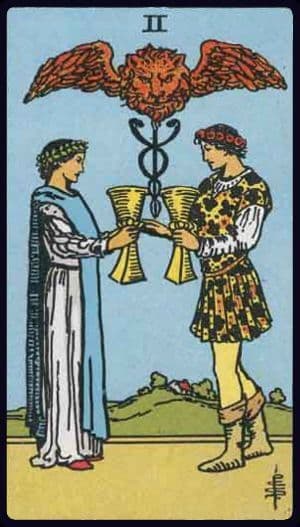
In the Rider-Waite-Smith tradition, the Two of Cups shows two figures facing one another and exchanging cups beneath a caduceus and a winged lion. As a two, the card marks the movement from raw potential into relationship, reflection, and polarity that can become harmony.
A grounded modern reading treats this card as a sign of reciprocity rather than a guarantee of destiny. It may point to meaningful connection, but it is best read as mutual willingness, emotional alignment, and active exchange rather than a fixed promise of soulmate union.
Symbolism of the Two of Cups
The Two of Cups is rich in relational symbolism. Its imagery emphasizes equality, exchange, and the possibility of healthy emotional meeting.
Key symbols commonly associated with this card include:
- The Facing Figures: Recognition, presence, and the willingness to meet another person directly rather than through projection or avoidance.
- The Exchanged Cups: Reciprocity, emotional offering, and the idea that connection is healthiest when both sides are participating.
- The Caduceus: Balance, exchange, and the integration of separate energies into a dynamic relationship.
- The Winged Lion: Passion lifted by awareness; instinct and desire shaped by consciousness and dignity.
- The Open Stance: Consent, availability, and an encounter shaped by mutual willingness rather than force.
Taken together, these symbols frame the Two of Cups as a card of equal exchange, relational honesty, and emotional alignment that remains alive because both sides are present.
Upright Meaning of Minor Arcana 23
When the Two of Cups appears upright, it often emphasizes:
- Mutual Recognition: A sense of being seen, met, and understood in a way that feels reciprocal rather than one-sided.
- Balanced Partnership: Emotional or practical collaboration built on respect, shared intention, and equal participation.
- Healing Connection: Repair, reconciliation, or a bond that softens defensiveness and supports trust.
- Aligned Exchange: Giving and receiving that feels natural, honest, and sustainable rather than draining or performative.
In practice, upright Two of Cups can suggest a promising relationship, a meaningful partnership, a restorative conversation, or the recognition that connection deepens when both sides show up clearly.
Reversed Meaning of Minor Arcana 23
Reversed, the Two of Cups may point to difficulty sustaining reciprocity or emotional alignment:
- Imbalance: One person may be giving more, investing more, or expecting more than the other can meet.
- Miscommunication: Feelings may be real, but the exchange is blocked by misunderstanding, avoidance, or unclear expectations.
- Over-Idealization or Dependency: Connection may be confused with rescue, fusion, or the hope that another person will complete what must be healed within.
- Distance or Delay: A bond may still matter, but the timing, readiness, or emotional maturity required for mutuality is not yet in place.
In this position, the Two of Cups does not always mean the bond is false. More often, it asks whether the relationship is truly reciprocal, clearly communicated, and grounded enough to hold what both people want from it.
Two of Cups in Real-Life Contexts
1. Love and Relationships
Upright: Upright, this card can indicate mutual attraction, emotional honesty, relationship repair, or the beginning of a bond where both people feel equally engaged.
Reversed: Reversed, it may point to mismatched feelings, blurred expectations, codependent patterns, avoidance, or care that is not being returned in a balanced way.
2. Career and Work
Upright: In work, the Two of Cups can show productive collaboration, trustworthy partnerships, aligned clients, or a shared vision that benefits from genuine cooperation.
Reversed: Reversed, it may suggest poor collaboration, misread intentions, unresolved tension with a colleague, or a partnership that looks good on paper but lacks real alignment.
3. Personal Growth
Upright: For personal growth, this card supports learning how to relate without self-abandonment, and how to welcome closeness while staying rooted in your own values and boundaries.
Reversed: Reversed, it can reveal people-pleasing, fear of rejection, over-merging, or the need to build self-worth before expecting mutuality from others.
Journal Prompts for the Two of Cups
- Where in my life am I being invited into a more mutual form of connection?
- What does healthy reciprocity look like to me in love, work, or friendship?
- Am I meeting others as an equal, or am I slipping into overgiving, chasing, or emotional dependence?
How to Work with Minor Arcana 23 in Readings
To engage the Two of Cups in a grounded way, try these practices:
- Meditation: Visualize a relationship that matters to you and notice where the energy feels balanced, withheld, or overextended. Pay attention to what equality actually feels like in your body.
- Journaling: Write about a bond that feels mutual and one that feels uneven. Compare how trust, communication, and emotional effort differ between them.
- Affirmations: Use phrases like I welcome connection that is mutual and honest and I can love without abandoning myself.
- Decision Practice: Before entering or deepening a partnership, ask not only Do I feel drawn here? but also Is there reciprocity, clarity, and shared willingness?
Spiritual Significance of Minor Arcana 23
Spiritually, the Two of Cups speaks to sacred mirroring. It reminds us that relationship can become a place where truth, vulnerability, and healing are reflected back to us through another person or through a balanced inner dialogue.
Its lesson is not that union solves everything, but that meaningful connection can reveal what is ready to be shared, repaired, and honored. Mutuality becomes a spiritual practice when it is entered consciously.
Reading Boundaries and Ethical Use
Tarot works best as a reflective and symbolic tool. It should not replace licensed medical, mental health, legal, or financial advice.
With the Two of Cups especially, ethical reading matters: do not promise soulmates, guaranteed reunion, or perfect compatibility. Read instead for reciprocity, communication, readiness, and the conditions that support healthy connection.
Conclusion
Minor Arcana 23 reminds us that real connection is not built on fantasy, but on presence, equality, and mutual exchange. The Two of Cups marks the point where feeling becomes relationship.
When the Two of Cups appears, ask yourself: Where am I ready to build connection that is honest, reciprocal, and strong enough to hold both people fully?
Continue the Tarot Journey
Related Tarot Cards
Ready to Calculate Your Arcana?
Use Arcana Calculator to find your Major Arcana tarot card by birth date and name. Get personalized numerology insights and spiritual guidance. Calculate yours now!
Calculate Now