Minor Arcana 27: Six of Cups - Nostalgia, Reconnection, Innocence, and Emotional Continuity
Introduction to Minor Arcana 27
Minor Arcana 27, the Six of Cups, is one of tarot’s clearest cards for emotional memory, innocence, and meaningful reconnection. It often appears when the past is not fully gone because it still has something to teach, heal, or restore.
This card is commonly associated with nostalgia, but its message is more grounded than simple sentimentality. The Six of Cups points to familiar emotional patterns, childhood imprints, old relationships, and the comfort of what once felt safe and sincere.
At its best, this card helps you reconnect with warmth, generosity, and emotional truth. At its most challenging, it warns against idealizing the past so much that the present cannot fully unfold.
For a broader comparison, pair it with Five of Cups and Seven of Cups to explore related themes and archetypes.
Historical Context and Reading Framework
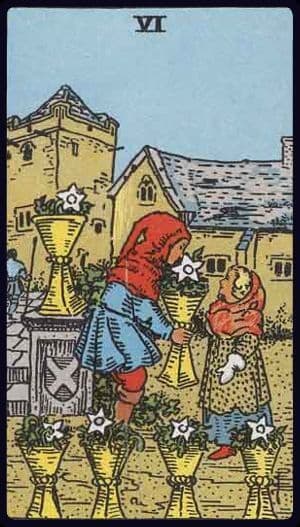
In the Rider-Waite-Smith tradition, the Six of Cups shows one figure offering a flower-filled cup to another within a protected scene. The image evokes kindness, memory, innocence, and the emotional atmosphere of what feels known and familiar.
As a six in the suit of Cups, this card often suggests a movement toward restoration after emotional disruption. A grounded modern reading sees it as memory, reconciliation, inner-child themes, and emotional continuity rather than escapist fantasy or blind innocence.
Symbolism of the Six of Cups
The Six of Cups is gentle on the surface, but its symbols carry real psychological depth. It speaks to what we revisit emotionally when we seek comfort, belonging, or unfinished understanding.
Key symbols commonly associated with this card include:
- The Two Figures: Exchange, kindness, remembered bonds, and the emotional impact of familiar people or roles returning to awareness.
- The Flower-Filled Cups: Tenderness, generosity, gifts from the past, and emotional material that is still alive rather than empty.
- The Protected Setting: Safety, innocence, and the desire to return to what once felt emotionally secure or uncomplicated.
- The Childlike Tone: Inner-child themes, early emotional conditioning, and the ways childhood memories still shape present responses.
- The Repeated Cups: Continuity between past and present, showing that memory does not disappear but becomes part of current emotional life.
Taken together, these symbols show that the Six of Cups is not just about looking backward. It is about understanding what from the past still lives inside the present.
Upright Meaning of Minor Arcana 27
When the Six of Cups appears upright, it often emphasizes:
- Nostalgia and Memory: The return of emotionally meaningful memories, people, or places that still carry warmth or significance.
- Reconnection: Renewed contact, reconciliation, or the emotional value of revisiting what once mattered.
- Inner-Child Healing: A chance to notice old emotional patterns with greater kindness, honesty, and care.
- Generosity and Sincerity: Simple kindness, open-hearted exchange, and emotional gestures that are free from unnecessary calculation.
In practice, the upright Six of Cups suggests letting the past inform the present without letting it imprison the present. Some memories are arriving not to trap you, but to help you reconnect with what is still true.
Reversed Meaning of Minor Arcana 27
Reversed, the Six of Cups may point to tension around the past and how it is being held:
- Idealizing the Past: Remembering only what felt beautiful while forgetting the complexity, limits, or pain that were also present.
- Emotional Immaturity: Reacting from old conditioning instead of responding from present-day awareness and responsibility.
- Difficulty Moving Forward: Clinging to old stories, roles, or relationships so tightly that growth becomes constrained.
- Healing Old Patterns: In some readings, this card can also show conscious work around childhood wounds, family imprinting, or emotional repetition.
In this position, the Six of Cups asks whether memory is supporting healing or quietly keeping you loyal to an outdated version of yourself.
Six of Cups in Real-Life Contexts
1. Love and Relationships
Upright: Upright, this card can indicate reconciliation, a familiar bond, a relationship shaped by shared history, or the return of feelings connected to the past.
Reversed: Reversed, it may suggest romanticizing an old connection, repeating childhood attachment patterns, or holding onto a version of love that no longer fits reality.
2. Career and Work
Upright: In work, the Six of Cups can point to trusted collaborators, returning opportunities, supportive environments, mentoring, or reconnecting with work that feels meaningful again.
Reversed: Reversed, it may show being overly attached to old methods, struggling to adapt, or making present decisions based on outdated comfort rather than current reality.
3. Personal Growth
Upright: For personal growth, this card supports inner-child reflection, emotional honesty, and reconnecting with values or joys that were once natural and unforced.
Reversed: Reversed, it may indicate that the past still has unresolved authority over your reactions and needs to be understood with more clarity and compassion.
Journal Prompts for the Six of Cups
- What from my past still brings genuine warmth, clarity, or emotional truth into my life today?
- Where am I confusing comfort with growth, or familiarity with what is actually healthy for me now?
- What old pattern or early memory deserves to be revisited with more compassion and less idealization?
How to Work with Minor Arcana 27 in Readings
To work with the Six of Cups in a grounded way, try these practices:
- Meditation: Visualize a meaningful memory and notice what part of it still wants your attention: comfort, grief, forgiveness, safety, or belonging.
- Journaling: Write about one memory that still shapes your emotional reactions today. Name both the gift it gave you and the limit it may now create.
- Affirmations: Use phrases like I can honor the past without living inside it and what was once true for me does not have to control every choice I make now.
- Decision Practice: Before returning to a person, habit, or place, ask whether you are responding to genuine alignment, emotional repair, or only the pull of familiarity.
Spiritual Significance of Minor Arcana 27
Spiritually, the Six of Cups points to the soul’s memory of tenderness, trust, and uncomplicated giving. It reminds us that softness is not weakness and that innocence, when integrated wisely, can become a source of strength.
Its lesson is not to go backward, but to carry forward what was pure, kind, and emotionally honest. The past becomes useful when it nourishes present consciousness instead of replacing it.
Reading Boundaries and Ethical Use
Tarot works best as a reflective and symbolic tool. It should not replace licensed medical, mental health, legal, or financial advice.
With the Six of Cups especially, ethical reading matters: do not promise automatic reunion, encourage regression, or assume every return is meant to be permanent. Read for emotional pattern, context, consent, and grounded choice.
Conclusion
Minor Arcana 27 reminds us that the past can still matter without needing to rule the present. The Six of Cups names memory, reconnection, and emotional continuity without demanding that we live backward.
When the Six of Cups appears, ask yourself: what am I being invited to remember, what deserves healing, and what from the past is worth carrying forward with open eyes?
Continue the Tarot Journey
Related Tarot Cards
Ready to Calculate Your Arcana?
Use Arcana Calculator to find your Major Arcana tarot card by birth date and name. Get personalized numerology insights and spiritual guidance. Calculate yours now!
Calculate Now