Arcana 15 (The Devil)
What The Devil (XV) Means in Practice
The Devil is one of the most misunderstood cards in the Major Arcana. Its imagery—dark, sensual, and provocative—often triggers immediate discomfort. Yet beneath the surface lies a profound message about human desire, illusion, and the possibility of reclaiming personal power.
In practical readings, The Devil rarely predicts external misfortune. Instead, it exposes internal dynamics: the attachments, addictions, and self-imposed limitations that keep us from moving forward. It is a mirror held up to the parts of ourselves we prefer not to see.
If you want to understand how your own archetypal patterns align with the broader Tarot cycle, the Arcana Calculator can reveal your personal Major Arcana number and its influence on your life path.
For a broader comparison, pair it with Temperance and The Tower to explore related themes and archetypes.
Core Meaning: Confronting Voluntary Bondage
At its center, The Devil represents voluntary bondage. The chains around the figures in traditional imagery are loose enough to remove—yet the captives remain. This is the card’s essential teaching: many of our limitations exist because we believe they are real, not because they are physically inescapable.
In readings, The Devil asks a difficult but necessary question: where are you giving away your autonomy? The answer may involve a relationship, a habit, a belief system, or a pattern of self-sabotage that has become normalized over time.
Key themes include: attachment, illusion of control, shadow integration, desire, and the reclaiming of personal agency.
Symbolism and Card Imagery
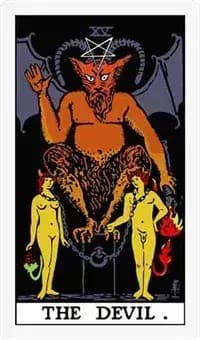
In the Rider-Waite-Smith tradition, The Devil depicts a horned, goat-like figure standing above two chained humans. The symbolism is deliberate and multilayered:
- The Horned Figure: Represents primal instincts, material desire, and the raw energy of the physical world. It is not purely evil—it embodies the life force that, when unchecked, becomes obsession.
- The Loose Chains: Symbolize self-imposed restriction. The figures could free themselves at any moment, but they remain bound by belief and habit rather than physical force.
- The Inverted Torch: Channels spiritual fire downward into material fixation, suggesting that energy directed only toward external gain loses its higher purpose.
- The Male and Female Captives: Echo The Lovers (Arcana VI), but here union is replaced by codependency. The message: even deep connection can become imprisonment when rooted in fear rather than choice.
Together, these symbols frame The Devil not as an external enemy, but as an internal architecture of belief. The card warns and invites in equal measure.
Psychological Depth: Jung’s Shadow and Integration
Carl Jung’s concept of the Shadow aligns closely with The Devil’s message. The Shadow contains all aspects of the self that have been rejected, suppressed, or deemed unacceptable—anger, lust, envy, and greed, but also vitality, courage, and creative intensity.
When the Shadow is ignored, it gains unconscious control. This manifests as destructive habits, compulsive behaviors, or manipulative relationships. When brought into conscious awareness, however, the Shadow becomes a source of integration, authenticity, and renewed energy.
The Devil does not tempt us into wrongdoing. It reveals where we have already surrendered our will. Awareness is the first and most essential step toward liberation.
Upright Meaning of The Devil
When The Devil appears upright, it typically signals one or more of the following patterns:
- Addiction or dependency, whether to substances, behaviors, approval, or narratives about the self.
- Toxic relationships characterized by control, fear, guilt, or codependency rather than mutual respect.
- Material obsession, where external validation, status, or accumulation overshadows inner growth.
- Self-limiting beliefs that have become so familiar they feel like identity rather than choice.
Paradoxically, The Devil also carries potential for empowerment. Naming the chain is the first act of breaking it. Awareness transforms the card from a warning into an invitation.
Reversed Meaning: Breaking the Chains
Reversed, The Devil signals the beginning of release. The illusions weaken, attachments dissolve, and clarity begins to emerge. The querent may be reclaiming control, setting boundaries, or seeing manipulation for what it is.
- Recognizing a toxic pattern and taking the first steps to exit it.
- Releasing guilt, shame, or belief systems that no longer serve growth.
- Reclaiming agency after a period of feeling trapped or powerless.
This is not instant transformation. It is the spark of truth before deeper change—often leading directly into The Tower (XVI), where old structures collapse to make room for authentic rebuilding.
Reading The Devil in Real-Life Contexts
Love and Relationships
Upright: Codependency, power imbalances, or staying in a connection out of fear rather than genuine alignment. The card asks whether love is freely given or silently demanded.
Reversed: Breaking free from unhealthy attachments, establishing boundaries, or realizing that a relationship has been rooted in projection rather than reality.
Career and Work
Upright: Being trapped in a role for status or security, tolerating exploitation, or pursuing wealth at the cost of integrity and well-being.
Reversed: Reclaiming professional autonomy, leaving a toxic environment, or redirecting ambition toward values-aligned goals.
Personal Growth
Upright: Unconscious patterns running the show; self-sabotage dressed as comfort; the avoidance of necessary but uncomfortable truth.
Reversed: The courage to confront shadow material, the decision to stop normalizing suffering, and the first steps toward integrated selfhood.
A Reliable Way to Read The Devil
To keep interpretations grounded and useful, apply this four-step approach:
- Name the Attachment: Identify what you are holding onto: a relationship, identity, habit, or belief. Be specific.
- Trace the Payoff: Ask what this attachment gives you that makes it hard to release—safety, validation, distraction, or familiarity.
- Assess the Cost: honestly measure what this pattern takes from your energy, growth, and authenticity.
- Choose One Liberation: Select a single, concrete step toward reclaiming agency. Small, consistent actions outperform dramatic declarations.
This method aligns with The Devil’s deeper teaching: freedom is not the absence of desire, but the conscious relationship with it.
Boundaries and Responsible Use
Tarot is a reflective instrument, not a substitute for medical, legal, financial, or mental health support. Use The Devil to deepen self-awareness and decision quality, while relying on qualified professionals when stakes are high.
If a reading triggers distress, prioritize regulation first. Pause interpretation, return to basic care, and seek support if needed. The goal of shadow work is integration, not overwhelm.
The Devil in the Fool's Journey
In the Major Arcana sequence, The Devil follows Temperance (XIV) and precedes The Tower (XVI). This placement is significant: after the integration of balance comes the confrontation with attachment, and after attachment comes the necessary collapse of illusion.
The Devil also mirrors The Lovers (VI). Where The Lovers choose union through conscious alignment, The Devil binds through unconscious need. Both cards deal with relationship—but one liberates, the other enslaves.
Within the Fool’s Journey, The Devil is the initiator of self-knowledge through darkness. It is not a punishment but a passage—one that prepares the soul for the breakthrough that follows.
Reflection Prompt and Closing
A practical reflection question for this card is:
"Where am I mistaking familiarity for safety, and what would I do if I believed I were free?"
The Devil teaches that liberation begins with radical honesty. We cannot transcend what we refuse to face. By acknowledging our desires, illusions, and fears, we reclaim the will to choose differently.
In the Tarot’s grand narrative, The Devil marks a crucial threshold—the descent that precedes awakening. Understood deeply, it reminds us that self-mastery arises through shadow, not despite it.
Continue the Tarot Journey
Related Tarot Cards
Ready to Calculate Your Arcana?
Use Arcana Calculator to find your Major Arcana tarot card by birth date and name. Get personalized numerology insights and spiritual guidance. Calculate yours now!
Calculate Now