Five of Wands - conflict, competition, and productive friction
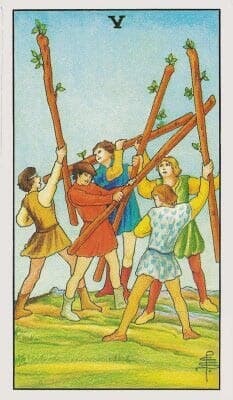
Five of Wands Overview
The Five of Wands is one of tarot's most recognizable images of tension. It often appears when multiple people, priorities, or desires are pushing at once and no one has yet found the shared rhythm that would turn effort into progress.
In readings, this card can point to conflict, competition, ego friction, creative disagreement, or simple misalignment. The atmosphere may feel noisy, but it is not always destructive. Very often, it is developmental.
Because of that, the Five of Wands is best understood not only as struggle, but as the stage where differences become visible. It shows what happens when energy is active, passionate, and real, but not yet coordinated.
For a broader comparison, pair it with Four of Wands and Six of Wands to explore related themes and archetypes.
Historical context and reading frame
In tarot, fives typically disrupt the stability established by fours. They introduce stress, movement, complexity, and the pressure that forces a structure to reveal its weaknesses or evolve into something more resilient.
Within the suit of Wands, the Five often speaks to active tension rather than passive hardship. Traditional imagery shows several figures lifting wands in what appears to be a chaotic exchange. The scene suggests rivalry, training, clashing viewpoints, or the energetic confusion that can arise when passion outpaces coordination.
Symbolism of the Five of Wands
The symbolism of the Five of Wands centers on friction in motion. This is not the stillness of hidden resentment. It is visible, animated, and immediate. The card captures the stage where energy is very much alive but has not yet been organized.
Key symbolic cues often include:
- Five active figures: Multiple participants suggest competing agendas, personalities, or ideas trying to occupy the same space.
- Raised wands crossing each other: The crossing lines symbolize collision, interruption, and effort that is meeting resistance from other effort.
- No clear winner: This card often reflects a situation that is still unresolved. The process matters more than an immediate outcome.
- Similar footing: The figures are often shown with comparable energy, suggesting rivalry among peers, equals, or overlapping forces.
- Open space and movement: The scene feels kinetic rather than trapped. This tension can still change, redirect, or become productive if given structure.
Taken together, these symbols suggest a temporary phase of clash and activation. The Five of Wands reminds us that friction is often the price of differentiation, growth, and finding a stronger form.
Upright meaning: conflict, testing, and emerging definition
Upright, the Five of Wands speaks to tension that has not yet settled into order. It often appears when energy is high but coordination is weak, or when people are trying to prove themselves in a crowded or competitive environment.
- Competition reveals skill: Rivalry can be stressful, but it may also sharpen ability, strengthen confidence, and clarify where your strengths really are.
- Friction before clarity: Disagreement is not always failure. Sometimes it is the stage that forces priorities, boundaries, and honest differences into the open.
- Too many active forces: This card often appears when there are many ideas, voices, tasks, or desires moving at once without a clear system.
- Testing ego and identity: The Five of Wands can ask how you respond when challenged, compared, interrupted, or made to defend your position.
In practical readings, the upright card often suggests that progress is possible, but only if the noise is channeled. It is less a sign of defeat than a sign that skill, direction, and alignment are still being forged through tension.
Reversed meaning: avoidance, exhaustion, or the beginning of resolution
Reversed, the Five of Wands can move in more than one direction. Sometimes it describes conflict that is being avoided or buried. Other times, it suggests that a chaotic situation is finally losing intensity and becoming easier to sort out.
- Conflict avoidance: Peace may be preserved outwardly while resentment, disagreement, or frustration continues underneath.
- Internalized tension: At times this card points to comparison, insecurity, or competition that is happening mainly inside you rather than in the outer environment.
- De-escalation and clearing: The noise may be reducing. Priorities can become clearer, and people may be starting to cooperate more effectively.
- Burnout from constant friction: If challenge has continued too long, this card can reflect fatigue, irritability, and a reduced capacity to keep fighting for space.
The reversed Five of Wands does not automatically mean harmony. More often, it asks whether tension is being processed honestly or merely pushed out of sight. Real resolution requires more than silence.
Five of Wands in love, work, and personal growth
Love and relationships
Upright: In love, the upright Five of Wands can show arguments, mixed signals, competing needs, jealousy, dating confusion, or a relationship where both people want to be understood but keep speaking past each other.
Reversed: Reversed, it may reflect suppressed tension, conflict avoidance, gradual reconciliation, or the realization that recurring drama is draining more energy than the connection can sustain.
Career and work
Upright: In career readings, this card often points to competition, crowded markets, team disagreement, overlapping responsibilities, office politics, or environments where people are pushing hard without enough coordination.
Reversed: Reversed, it can indicate reduced conflict, clearer structure, or the need to step out of unhealthy comparison, chronic defensiveness, or work cultures built on constant rivalry.
Personal growth
Upright: For personal growth, the upright Five of Wands can be a powerful sign that identity is being tested into stronger form. It asks what you learn about yourself when your position is challenged.
Reversed: Reversed, it may suggest that you are tired of proving yourself, still carrying old competition internally, or beginning to choose alignment over endless reactive struggle.
Journal prompts for the Five of Wands
- Where in my life is friction revealing something important rather than simply getting in the way?
- What am I actually fighting for: clarity, recognition, control, or space to be heard?
- How can I turn scattered effort into coordinated action without losing my own voice?
Working with the Five of Wands
The Five of Wands asks for conscious engagement with tension. It does not require you to enjoy conflict, but it does ask you to notice what pressure is trying to define, expose, or refine.
- Meditation: Visualize noisy energy gathering into a clearer pattern and notice what changes when movement is organized instead of resisted.
- Journaling: Write down the competing demands, voices, or priorities in your current situation and identify which ones truly deserve space.
- Affirmation: I can meet friction with clarity instead of turning every challenge into chaos.
- Decision practice: Choose one conflict or area of competition this week and focus on improving structure, communication, or boundaries rather than simply pushing harder.
Spiritual significance
Spiritually, the Five of Wands speaks to the friction of individuation. It marks the stage where desire, will, and identity do not yet move in harmony, but are beginning to reveal their true shape through contact and resistance.
This card reminds us that not all spiritual growth feels peaceful. Sometimes awakening includes collision, comparison, testing, and the effort of learning how to hold strong energy without scattering it.
Reading boundaries and practical cautions
The Five of Wands does not guarantee open hostility, abuse, or disaster every time it appears. It often speaks more specifically to tension, competition, noise, and developmental conflict rather than irreversible damage.
In practical readings, this card is strongest when read as active friction that still has room to evolve. It is most useful for naming where coordination, boundaries, or honest communication are needed before growth can stabilize.
Conclusion
The Five of Wands is a card of friction that reveals form. It appears when competing energies can no longer stay vague and must begin testing themselves against reality and against each other.
Its message is challenging but valuable: do not confuse noise with failure. Sometimes conflict is the very process through which clarity, skill, and stronger direction become possible.
Continue the Tarot Journey
Related Tarot Cards
Ready to Calculate Your Arcana?
Use Arcana Calculator to find your Major Arcana tarot card by birth date and name. Get personalized numerology insights and spiritual guidance. Calculate yours now!
Calculate now