Ten of Wands - burden, responsibility, and release
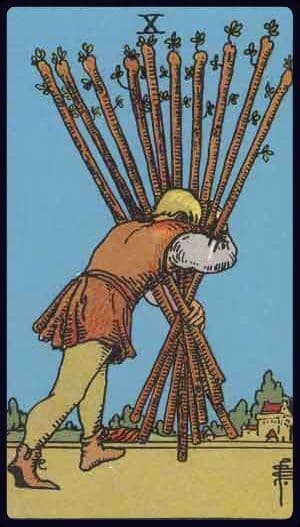
Ten of Wands Overview
The Ten of Wands is one of tarot’s clearest cards of overload. It often appears when effort has become strain, success has become heavy, or responsibility has accumulated to the point where it is hard to keep carrying everything alone.
In readings, this card can point to burden, pressure, overcommitment, exhaustion, emotional weight, and the realization that being capable does not mean you must carry every task, expectation, or problem by yourself.
Because of that, the Ten of Wands is not only about hard work. It is about the relationship you have with hard work. The card asks what you are carrying because it matters, and what you are carrying because you no longer question the load.
For a broader comparison, pair it with Nine of Wands and Page of Wands to explore related themes and archetypes.
Historical context and reading frame
In tarot, tens often describe completion, culmination, and the final form of a suit’s lesson. They show what happens when a pattern fully matures and reaches its most visible consequence.
Within the suit of Wands, the Ten traditionally represents the weight that comes after prolonged effort and ambition. Classic imagery shows a figure bent forward under the load of ten wands, linking the card to labor, burden, responsibility, and the cost of carrying too much too far.
Symbolism of the Ten of Wands
The symbolism of the Ten of Wands centers on accumulated weight. Unlike cards that emphasize excitement or clean momentum, this one focuses on strain, compression, and the pressure created when too much is being held at once.
Key symbolic cues often include:
- Ten wands carried together: The full bundle symbolizes excess load, accumulation, and responsibilities that have become difficult to separate or manage.
- Bent posture: The figure’s posture reflects physical and emotional heaviness, effort, and limited visibility under pressure.
- Forward movement despite strain: Even under the load, the figure is still moving, showing endurance but also the cost of continuing without relief.
- Obstructed view: The wands block sight, symbolizing how burden can narrow perspective and make it harder to see options clearly.
- Nearness to destination: The card often suggests that completion is close, but that the path there has become heavier than it needs to be.
Together, these symbols describe a stage of compressed effort. The Ten of Wands reminds us that finishing something is not always the same as carrying it wisely.
Upright meaning: overload, responsibility, and unsustainable effort
Upright, the Ten of Wands speaks to pressure and overextension. It often appears when you are still functioning, still producing, and still meeting expectations, but the cost of doing so is no longer hidden.
- Too much to carry: This card often indicates responsibilities, expectations, or emotional burdens that have exceeded what is healthy to sustain alone.
- Competence becoming overload: At times the Ten appears because you are capable, reliable, or hardworking enough that others place more and more on you.
- Success with strain: You may be near completion or even outwardly successful, but the process has become draining rather than empowering.
- The need to reassess: This card asks whether every obligation still belongs to you, or whether some part of the load now needs to be delegated, released, or refused.
In practical readings, the upright Ten of Wands is less about failure than about unsustainable weight. It suggests that endurance alone is no longer enough; smarter carrying is needed.
Reversed meaning: release, burnout, or learning to put the load down
Reversed, the Ten of Wands can indicate collapse under pressure, but it can also indicate relief beginning. Sometimes it reflects burnout. Sometimes it marks the first honest decision to stop carrying everything in the same way.
- Burnout and breaking point: You may have reached the limit of what your energy, time, or emotional capacity can reasonably hold.
- Letting go: At times the reversed card points to delegation, release, simplification, or finally admitting that some burdens were never yours to begin with.
- Relief through honesty: Progress may come not from pushing harder, but from telling the truth about what is too much.
- Resisting release: In some readings, the card warns that clinging to duty or control may be preventing the relief you need.
The reversed Ten of Wands does not always mean defeat. More often, it asks whether freedom begins the moment you stop confusing burden with value.
Ten of Wands in love, work, and personal growth
Love and relationships
Upright: In love, the upright Ten of Wands can point to a relationship weighed down by unresolved stress, unequal emotional labor, external pressure, or the feeling that care has become obligation rather than mutual support.
Reversed: Reversed, it may reflect emotional release, a need to stop carrying the relationship alone, clearer conversations about imbalance, or recognition that love cannot thrive when burden replaces partnership.
Career and work
Upright: In career readings, this card often signals workload overload, over-responsibility, unrealistic expectations, or professional success that has become draining because too much rests on one person’s shoulders.
Reversed: Reversed, it can indicate burnout, stepping back, delegating, reducing commitments, or realizing that constant overperformance is no longer sustainable or wise.
Personal growth
Upright: For personal growth, the upright Ten of Wands teaches that strength without limits becomes self-burdening. It asks where you have confused worth with carrying more than is yours.
Reversed: Reversed, it may suggest that growth now requires release: simplifying, resting, asking for help, and allowing your identity to exist apart from constant responsibility.
Journal prompts for the Ten of Wands
- What am I carrying that truly belongs to me, and what am I carrying out of habit, guilt, or fear?
- Where in my life has competence quietly turned into overload?
- What would change if I believed that letting go could also be a form of strength?
Working with the Ten of Wands
The Ten of Wands asks for conscious unloading. It is not a card that praises endless pressure. It invites you to notice what has become too heavy and to create relief before exhaustion becomes collapse.
- Meditation: Visualize yourself setting down part of a load and notice which burdens feel essential, which feel inherited, and which feel ready to be released.
- Journaling: List all current obligations, then separate the ones that are truly yours from the ones maintained mainly by guilt, control, or expectation.
- Affirmation: I do not have to carry everything to prove that I am strong, responsible, or worthy.
- Decision practice: Choose one obligation to delegate, simplify, postpone, or release this week, and observe what that shift does to your energy.
Spiritual significance
Spiritually, the Ten of Wands speaks to the burden of over-identification with responsibility. It often appears when your inner fire has become entangled with proving, carrying, or earning your worth through strain.
This card reminds us that effort can be sacred, but suffering is not always required. Sometimes spiritual maturity means learning to release what no longer belongs to you, even when your identity has been built around holding it.
Reading boundaries and practical cautions
The Ten of Wands does not automatically mean disaster, punishment, or that hard work is bad. More often, it reflects imbalance, accumulated burden, overcommitment, and the cost of carrying too much without adjustment.
In practical readings, this card is strongest when read as a warning about unsustainable weight. It helps identify where responsibility has become excess and where relief is now part of the lesson.
Conclusion
The Ten of Wands is a card of burdened completion. It appears when progress, duty, or ambition has become heavy enough that continuing in the same way is no longer wise.
Its message is clear: respect what matters, release what does not belong to you, and remember that true strength includes knowing when to stop carrying the whole load alone.
Continue the Tarot Journey
Related Tarot Cards
Ready to Calculate Your Arcana?
Use Arcana Calculator to find your Major Arcana tarot card by birth date and name. Get personalized numerology insights and spiritual guidance. Calculate yours now!
Calculate now