Page of Swords - curiosity, new ideas, and mental alertness
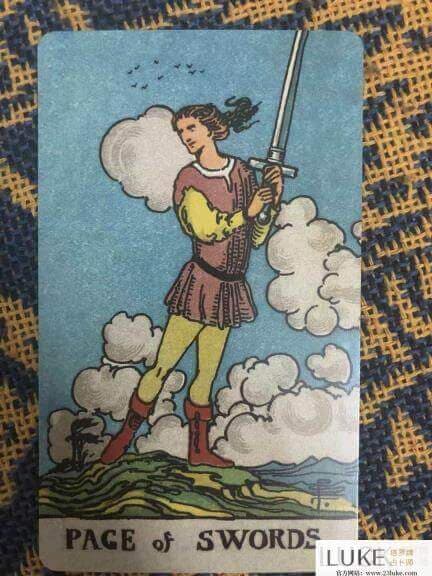
Page of Swords Overview
The Page of Swords is the court card of curiosity, quick thinking, and mental alertness. In the Swords suit, which is ruled by air and the realm of thought, the Page appears as the student and messenger: the part of you that asks questions, notices details, and refuses to accept surface answers.
After the Ten of Swords closes a painful chapter, the Page of Swords arrives with a lighter mind. It does not claim mastery. It claims interest. New information, a fresh idea, a question worth pursuing, or a conversation that sharpens your thinking often marks this card's arrival.
A responsible reading treats this card honestly: intellectual energy is powerful but needs direction. The same alertness that uncovers truth can become interrogation, cynicism, or gossip when it is not grounded in care. Tarot here is a reflective tool for noticing how you think, not a prediction of what messages will arrive.
Read this card in the wider Swords journey
These related guides show how the Page of Swords builds on the themes of the Swords sequence:
- Ace of Swords: Start here for the clarity and truth that give curiosity a trustworthy foundation.
- Two of Swords: Compare it with the guarded pause of decision-making when the mind is torn.
- Three of Swords: Use this to remember that sharp thinking must make room for grief and the heart.
- Four of Swords: Read this as the rest that keeps an active mind from tipping into exhaustion.
- Five of Swords: Look here for the difference between seeking truth and winning an argument.
- Six of Swords: Read this to understand how the mind moves toward calmer waters after conflict.
- Seven of Swords: Compare this with strategy, secrecy, and the cost of hidden information.
- Eight of Swords: Use this as the reminder that alertness can see the trap that fear has built.
- Nine of Swords: Read this to see how unchecked questioning can spiral into worry and anxiety.
- Ten of Swords: Begin here for the painful ending that clears the mind for something new.
- Minor Arcana - Swords: Browse the full suit to see how thought, truth, conflict, recovery, and release unfold across the Swords sequence.
For a broader comparison, pair it with Ten of Swords and Knight of Swords to explore related themes and archetypes.
Historical context and reading frame
In traditional tarot, Pages were read as messengers, young people, or the beginning of a development that has not yet matured. In the Swords suit, that beginning is mental: a question, a piece of information, a study, or a perspective still taking shape.
Modern decks often assign the Page of Swords the elemental title Earth of Air. That combination is useful: the card carries the curiosity and speed of air, grounded in the patience and practicality of earth. It describes a mind that wants facts, checks details, and learns by observing before it commits to a verdict.
Symbolism of the Page of Swords
In the Rider-Waite-Smith image, a young figure stands on uneven rocky ground, holding a sword upright in both hands. Wind bends the clouds and trees behind them, and birds cross the sky in the distance.
The figure looks alert rather than aggressive. The sword is raised for attention, not attack. The scene captures a mind waking up: curious, watchful, and still deciding what to make of what it sees.
- The upright sword: A new idea or question held with both attention and caution, ready to be examined.
- The youthful figure: The learner and observer, not yet the master; a mind still open to correction.
- The rocky ground: The need for facts and a real foundation before ideas are trusted or shared.
- The wind and clouds: Rapid thought, movement, restlessness, and information arriving from many directions.
- The distant birds: Omens, messages, and signals that a watchful mind is ready to notice.
Taken together, these symbols show why the Page of Swords is not yet a statement but a beginning: a mind alert to truth, still learning how to aim its attention.
Upright meaning: curiosity, alertness, and the courage to ask
Upright, the Page of Swords often emphasizes:
- Curiosity and questioning: A genuine desire to understand, investigate, and look beneath surface explanations.
- Mental alertness: Vigilance, quick observation, and the ability to notice details others miss.
- New ideas and fresh perspectives: A study, a conversation, a piece of news, or a way of seeing that opens the mind.
- Honest communication: The messenger role: speaking clearly, asking well, and relaying information accurately.
Upright, this card is a promise rather than a result. The mental energy is present and useful, but it needs focus, patience, and care to become wisdom instead of noise.
Reversed meaning: gossip, cynicism, and scattered thinking
Reversed, the Page of Swords points to the shadow side of a sharp mind. Common themes include:
- Gossip and harsh words: Intelligence used to cut, criticize, or spread half-formed judgments about others.
- Cynicism and intellectual arrogance: Using cleverness to dismiss rather than understand, or treating every discussion as a contest.
- Scattered thinking: Many questions and no direction; starting everything and finishing little.
- Knowledge without care: Facts used to manipulate, deceive, or win at the cost of honesty and relationship.
Reversed does not mean the mind is broken. More often, it suggests that curiosity has lost its grounding. The task is to aim the same alertness toward understanding instead of advantage.
Page of Swords in love, work, and personal growth
Love and relationships
Upright: In love, the Page of Swords can indicate curious conversation, intellectual connection, playful banter, or a relationship that grows through honest questions and open communication.
Reversed: Reversed, it may point to sharp words, gossip, overanalyzing a partner's messages, or using cleverness to avoid emotional vulnerability.
Work and creative direction
Upright: In work, this card often signals learning, research, new skills, or a project that rewards careful observation and clear communication.
Reversed: Reversed, it can suggest jumping between ideas without follow-through, careless emails, office gossip, or criticism that damages collaboration.
Personal growth and spiritual practice
Upright: For growth, the card encourages lifelong learning, honest self-inquiry, and the courage to revise what you believe when new facts appear.
Reversed: Reversed, it asks whether intellect has become a shield: a way to debate feelings, dismiss intuition, or stay safely above genuine reflection.
Journal prompts for the Page of Swords
- What question have I been avoiding because the answer might change something?
- Where is my curiosity serving truth, and where has it become a way to win or defend?
- What would it look like to learn something slowly, without needing to prove I already know it?
Working with the Page of Swords
If you want to work with this card in a grounded way, try these practices:
- Observation practice: Spend a few minutes noticing your thoughts without chasing them. Watch how quickly the mind reaches for judgment, and let a question sit open a little longer.
- Journaling: Write down the questions, ideas, and news that keep returning. Separate what is worth pursuing from what is only noise.
- Affirmation: I can be curious without being combative, and alert without being anxious.
- Decision-making: Before sharing a sharp thought, ask: is this accurate, is this kind, and does it need to be said now?
Spiritual significance
Spiritually, the Page of Swords represents the intellect as a servant of truth rather than a weapon. The mind is a gift, and its highest use is understanding, not advantage.
Its lesson is humility in thinking. Wisdom begins when curiosity stays open long enough to be corrected by reality, by other people, and by time.
Reading boundaries and practical cautions
The Page of Swords is not a prediction of specific messages, events, or gossip, and it does not diagnose attention, communication, or mental health conditions. Tarot is a reflective tool for exploring patterns, not a substitute for professional care or direct communication.
If this card brings up persistent distress about how you think, speak, or relate to others, use it as encouragement to seek qualified support and to say what matters directly to the people involved.
Conclusion
The Page of Swords is one of the most open-ended cards in the Swords suit. It does not announce a verdict. It announces that the mind is awake, curious, and ready to learn.
Read well, this card invites you to ask better questions, hold new information with patience, and let your intelligence serve truth and care rather than winning or defense.
Continue the Tarot Journey
Related Tarot Cards
Ready to Calculate Your Arcana?
Use Arcana Calculator to find your Major Arcana tarot card by birth date and name. Get personalized numerology insights and spiritual guidance. Calculate yours now!
Calculate now