Six of Swords - transition, recovery, and moving toward calmer water
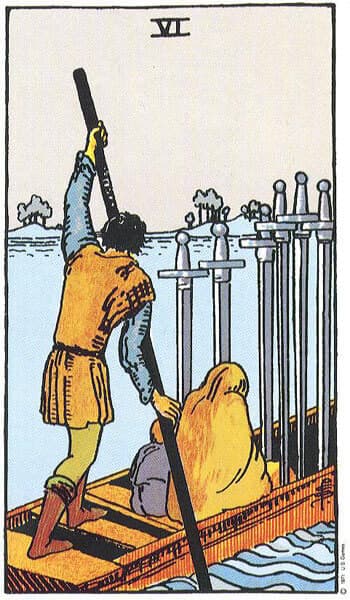
Six of Swords Overview
The Six of Swords is the tarot card of transition, recovery, and moving away from rough water. It often appears when a difficult chapter is ending, even if the next destination is still forming in the distance.
After the Five of Swords shows the cost of conflict, the Six of Swords asks what becomes possible when you stop fighting the same battle and choose a safer current. It is not always easy, but it is usually more intelligent than staying in the storm.
This card does not promise instant peace or a perfect arrival. It points to a process: leaving behind what has become too costly, carrying forward the lessons that still matter, and allowing time to restore perspective.
Read this card in the wider Swords journey
These related guides show how the Six of Swords follows the earlier Swords sequence:
- Ace of Swords: Start here to see how clarity begins the whole Swords journey.
- Two of Swords: Compare this transition with the guarded stillness that can delay a needed decision.
- Three of Swords: Read this to understand the pain that may have made movement necessary.
- Four of Swords: Use this as the pause that helps the mind recover before it travels onward.
- Five of Swords: Look here to see the conflict, strain, and hollow victory that often precede a true departure.
- Minor Arcana - Swords: Browse the full suit to see thought, conflict, grief, rest, transition, and repair unfold across the Swords sequence.
For a broader comparison, pair it with Five of Swords and Seven of Swords to explore related themes and archetypes.
Historical context and reading frame
In traditional tarot, sixes often describe movement toward balance after the instability of the fives. In the Swords suit, that movement tends to be mental, emotional, and relational: leaving behind conflict, finding better footing, or crossing from pain toward perspective.
A grounded modern reading treats the Six of Swords as a sign of transition rather than escape. It may point to travel, relocation, therapy, mediation, grief processing, or a decision to stop rehashing the same wound and move toward steadier ground.
Symbolism of the Six of Swords
In the Rider-Waite-Smith image, a figure rows a boat carrying passengers and six swords across calm water. The water ahead is smoother, but the passengers still sit with their burdens, suggesting that movement and healing happen together.
The scene is quiet, practical, and suspended between places. It does not erase what came before; it shows the wisdom of moving through it carefully.
- The boat: A vessel for transition, support, and passage from one state to another.
- The rower: A guide, helper, therapist, mediator, or the part of you that can carry the process forward.
- The passengers: People or parts of self who are tired, cautious, and still carrying the effects of what happened before.
- The six swords: What is being carried forward mentally: lessons, memories, strategy, or unresolved thoughts.
- The calmer water: A better emotional climate, even if the journey is not complete yet.
Taken together, these symbols show why the Six of Swords is a card of gentle progress: it honors movement without pretending the past was harmless.
Upright meaning: transition, healing movement, and wiser distance
Upright, the Six of Swords often emphasizes:
- Moving on: A chapter is ending, and you may be ready to leave behind a conflict, environment, or mindset that has become too heavy.
- Recovery in motion: Healing is not only rest; sometimes it is the act of moving toward a safer context with more support.
- Mediation and guidance: A helper, advisor, therapist, or trusted process may be easing the crossing.
- Perspective: Distance can make truth clearer, especially when emotions have been too loud to hear it well.
This card asks whether you are ready to choose the route that protects your future, not just the one that feels familiar.
Reversed meaning: resistance, baggage, or difficulty completing the crossing
Reversed, the Six of Swords often points to:
- Staying too long: You may know a situation is no longer right, but fear or habit keeps you from moving.
- Carrying baggage: Old thoughts, resentments, or unfinished grief may be coming along for the ride.
- Interrupted healing: Transition may be happening, but not smoothly enough for the nervous system to settle.
- Returning to the storm: Sometimes reversed shows a pull back into the very dynamic you were trying to leave.
Reversed does not always mean the move is wrong. It may simply ask what is still being carried, what still needs naming, and what support is missing before the journey can truly land.
Six of Swords in love, work, and personal growth
Love and relationships
Upright: In love, the Six of Swords can show a relationship healing after conflict, a calmer phase after turmoil, or the wisdom of taking space to avoid repeating damage.
Reversed: Reversed, it may point to emotional luggage, unfinished conversations, difficulty leaving a harmful pattern, or trying to move on before repair is complete.
Work and creative direction
Upright: In work, this card may indicate a move to a better team, a calmer role, a needed transition, mediation, or leaving a toxic environment.
Reversed: Reversed, it can suggest stalled plans, dragging old workplace conflict into a new setting, or being unable to detach from stress after hours.
Personal growth and spiritual practice
Upright: For growth, the card supports grief processing, therapy, perspective shifts, and learning how to travel with experience rather than be ruled by it.
Reversed: Reversed, it asks whether you are using movement to avoid feeling, or whether you are still asking the past to explain your present.
Journal prompts for the Six of Swords
- What am I ready to leave behind because staying has become too costly?
- What do I need to carry with me, and what can I set down before moving forward?
- What support would make this transition safer and more honest?
Working with the Six of Swords
If you want to work with this card in a grounded way, try these practices:
- Transition pause: Sit quietly and imagine the next bridge, boat, or road that helps you move toward calmer ground.
- Journaling: List what you are leaving, what you are learning, and what support you need for the next stretch.
- Affirmation: I can move toward calmer water without denying what the storm taught me.
- Transition planning: Before making a move, map the practical steps, emotional support, and timeline that make the crossing possible.
Spiritual significance
Spiritually, the Six of Swords is the passage between identities. It asks whether you can honor what hurt you, release what no longer serves, and trust a quieter intelligence to guide the next stage.
Its lesson is that healing is often movement with intention. Not every departure is rejection; sometimes it is faithful stewardship of your future.
Reading boundaries and practical cautions
The Six of Swords does not guarantee that travel, breakup, therapy, or relocation will solve everything. Tarot is a reflective tool, not a substitute for medical, legal, psychological, or safety guidance.
If this card appears around serious stress, use it to ask what transition is actually needed, what support is available, and whether you are trying to move before you are resourced enough to do so safely.
Conclusion
The Six of Swords reminds us that leaving can be an act of wisdom. It asks you to move toward calmer water without pretending the storm never mattered.
When read well, the card does not promise perfection. It offers passage, perspective, and the quiet dignity of choosing a better direction.
Continue the Tarot Journey
Related Tarot Cards
Ready to Calculate Your Arcana?
Use Arcana Calculator to find your Major Arcana tarot card by birth date and name. Get personalized numerology insights and spiritual guidance. Calculate yours now!
Calculate now