Five of Swords - conflict, hollow victory, and choosing the cost of winning
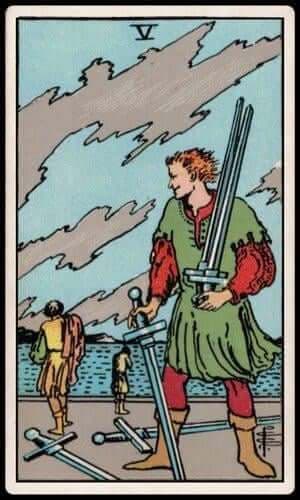
Five of Swords Overview
The Five of Swords is the tarot card of conflict with a cost. It often appears when words have become weapons, when winning matters more than repair, or when a person is left asking whether being right was worth the damage.
After the Four of Swords asks for rest and restraint, the Five of Swords shows what can happen when tension returns without enough humility. The mind is sharp, but sharpness alone does not make an action wise.
This card does not always mean someone is cruel or that a relationship is doomed. At its healthiest, it asks for ethical clarity: what battle are you fighting, what are you willing to lose to win it, and where would de-escalation be stronger than domination?
Read this card in the wider Swords journey
These related guides show how the Five of Swords develops from earlier Swords themes:
- Ace of Swords: Start here to see how clarity can become a tool, a boundary, or a blade depending on how it is used.
- Two of Swords: Compare it with the stalemate and guarded silence that can precede open conflict.
- Three of Swords: Read this to understand the wound or painful truth that can fuel defensiveness and resentment.
- Four of Swords: Use this as the necessary pause before returning to a conversation that could otherwise become destructive.
- Minor Arcana - Swords: Browse the full suit to see how thought, conflict, grief, rest, and repair unfold across the Swords sequence.
For a broader comparison, pair it with Four of Swords and Six of Swords to explore related themes and archetypes.
Historical context and reading frame
In traditional tarot, fives often describe disruption, instability, testing, and conflict within an established structure. In the Swords suit, that disruption happens through language, argument, tactics, pride, and the struggle to control the story.
A grounded modern reading treats the Five of Swords as a warning about cost rather than a simple prediction of defeat. It can show arguments, power games, social fallout, workplace politics, boundary conflicts, or the aftermath of a win that no longer feels clean.
Symbolism of the Five of Swords
In the Rider-Waite-Smith image, a figure gathers swords while two others walk away in the distance. The sky is uneven, the sea looks unsettled, and the victor’s expression can feel satisfied, wary, or strangely empty.
The scene does not celebrate victory. It asks what kind of victory has occurred, who paid for it, and whether the swords being collected are trophies, defenses, or evidence of a relationship damaged by conflict.
- The collected swords: Arguments, leverage, facts, weapons, or advantages gathered after a confrontation.
- The walking figures: People withdrawing, losing trust, choosing not to continue, or carrying the emotional cost of conflict.
- The victor’s posture: Pride, self-protection, strategic thinking, or the uneasy feeling that a win may not be as satisfying as expected.
- The unsettled water: Emotional consequences moving beneath a conflict that may look intellectual on the surface.
- The cloudy sky: Mental tension, unclear ethics, and the aftermath that lingers after harsh words or sharp decisions.
Together, these symbols show why the Five of Swords is uncomfortable: it forces the reader to ask not only who won, but what winning changed.
Upright meaning: conflict, power struggles, and victory with a price
Upright, the Five of Swords often emphasizes:
- Conflict and argument: A disagreement may be escalating through defensiveness, harsh language, pride, or unwillingness to listen.
- Hollow victory: You may technically win the point while damaging trust, goodwill, or long-term peace.
- Self-interest: The card can reveal places where survival, ego, or fear is overriding fairness and empathy.
- Strategic retreat: Sometimes the wisest move is not to keep arguing, but to step back before the cost grows.
This card asks for honesty about motive. Are you seeking truth, protection, accountability, revenge, control, or simply the relief of having the last word?
Reversed meaning: making amends, refusing the game, or unresolved resentment
Reversed, the Five of Swords often points to:
- De-escalation: A person may be ready to stop fighting, soften language, or choose repair over proving a point.
- Accountability: The card can invite apology, honest review, and ownership of harm caused by words or tactics.
- Lingering resentment: Conflict may appear quiet on the surface while bitterness, mistrust, or unspoken anger remains.
- Refusing manipulation: In some readings, reversed shows a decision not to participate in power games, gossip, or ego battles.
Reversed can be hopeful, but it is not automatic repair. It asks whether people are truly changing the pattern or only avoiding the discomfort of naming what happened.
Five of Swords in love, work, and personal growth
Love and relationships
Upright: In love, the Five of Swords can show arguments, coldness, blame, defensiveness, scorekeeping, or a moment when winning the fight threatens the bond.
Reversed: Reversed, it can point to apology, conflict recovery, a refusal to keep repeating the same argument, or the need to address resentment before trust can return.
Work and creative direction
Upright: In work, this card may indicate office politics, competitive pressure, harsh feedback, a difficult negotiation, or a win that damages team morale.
Reversed: Reversed, it may suggest mediation, stepping away from a toxic dynamic, repairing professional trust, or choosing strategy without cruelty.
Personal growth and spiritual practice
Upright: For growth, the card challenges pride, defensiveness, and the habit of confusing control with safety.
Reversed: Reversed, it asks whether you are ready to stop rehearsing old arguments and reclaim energy from battles that no longer deserve your attention.
Journal prompts for the Five of Swords
- Where am I trying to win, and what might that victory cost in trust, peace, or self-respect?
- What truth needs to be said without turning it into a weapon?
- What would de-escalation look like if I still protected my boundary?
Working with the Five of Swords
If you want to work with this card in a grounded way, try these practices:
- Pause before reply: Before responding to conflict, take three slow breaths and ask what outcome your next sentence serves.
- Journaling: Write the argument from three views: yours, theirs, and the long-term relationship or project.
- Affirmation: I can protect my truth without making harm my strategy.
- Conflict hygiene: Separate the issue, the person, and the power dynamic before deciding whether to engage, pause, apologize, or walk away.
Spiritual significance
Spiritually, the Five of Swords tests how the mind uses power. It asks whether intelligence is serving truth and protection, or whether it has become a way to dominate, punish, or stay defended.
Its lesson is ethical discernment. Not every battle is sacred, not every silence is weakness, and not every victory is aligned with the person you are becoming.
Reading boundaries and practical cautions
The Five of Swords does not prove betrayal, abuse, or bad intent by itself. Tarot is a reflective tool, not a substitute for evidence, professional mediation, legal guidance, mental health support, or safety planning.
If this card appears around serious conflict, use it to examine power, language, boundaries, and consequences. If safety is involved, prioritize qualified support and practical protection over symbolic interpretation.
Conclusion
The Five of Swords reminds us that conflict reveals character. It asks whether the need to win is protecting something real or simply keeping the nervous system armed.
When you meet this card well, you do not surrender your truth. You choose how to hold it, how to speak it, and whether the battle in front of you is worth the person it asks you to become.
Continue the Tarot Journey
Related Tarot Cards
Ready to Calculate Your Arcana?
Use Arcana Calculator to find your Major Arcana tarot card by birth date and name. Get personalized numerology insights and spiritual guidance. Calculate yours now!
Calculate now