Four of Swords - rest, recovery, and the healing pause
Four of Swords Overview
The Four of Swords is the tarot card of intentional rest. It often appears after stress, conflict, heartbreak, illness, burnout, or a period of mental overextension when the nervous system needs quiet before wise action can return.
Unlike the Three of Swords, which names the wound, the Four of Swords shows the protected space after impact. The focus shifts from reacting to recovering, from analyzing the pain to creating enough stillness for repair.
This card is not laziness or avoidance by default. At its healthiest, it is strategic retreat: silence, sleep, prayer, therapy, reduced stimulation, and the humility to admit that clarity may require rest before another decision is made.
Read this card in the wider Swords journey
These related guides give useful context for the mental and emotional sequence around the Four of Swords:
- Ace of Swords: Start here for the first blade of clarity and the clean insight that begins the Swords arc.
- Two of Swords: Compare it with the guarded pause that happens before a difficult truth is fully faced.
- Three of Swords: Read this to understand the wound, heartbreak, or painful truth that often makes recovery necessary.
- Minor Arcana - Swords: Browse the full suit to see how thought, conflict, grief, and restoration unfold across the Swords sequence.
For a broader comparison, pair it with Three of Swords and Five of Swords to explore related themes and archetypes.
Historical context and reading frame
In traditional tarot, fours often describe structure, containment, stabilization, and the shape that follows movement. In the Swords suit, that stabilizing force is mental quiet: a protected room for reflection, recuperation, and suspended conflict.
A grounded modern reading treats the Four of Swords as a needed interval rather than a permanent withdrawal. It can point to recovery after stress, a healing period, a sabbatical, a pause in communication, or the disciplined choice to stop escalating a conflict.
Symbolism of the Four of Swords
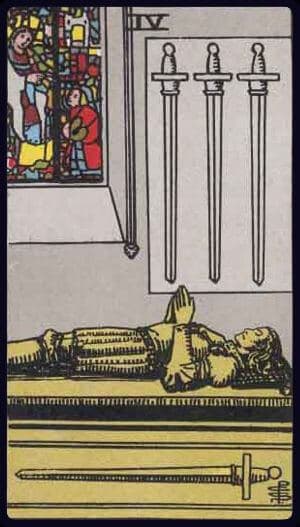
In the Rider-Waite-Smith image, a figure lies still on a tomb or resting platform with hands folded in prayer. Three swords hang above, one sword rests beneath, and a stained-glass window suggests sanctuary, memory, and spiritual protection.
The scene is quiet but not empty. It shows the kind of stillness that contains thought, grief, and recovery without demanding immediate movement.
- The reclining figure: Rest, convalescence, surrender, and the body asking the mind to stop pushing for a while.
- Folded hands: Prayer, reflection, intention, and the practice of turning inward without abandoning reality.
- The three swords above: Recent stress, heartbreak, conflict, or mental pressure still present in the atmosphere.
- The sword beneath: A stable inner truth, boundary, or reserve of clarity that remains available after rest.
- The stained glass: Sanctuary, support, memory, and the possibility that healing needs a protected environment.
Together, these symbols show why the Four of Swords is a deeply practical card: rest is not the absence of work, but the condition that allows the next work to be wise.
Upright meaning: rest, recovery, and protected stillness
Upright, the Four of Swords often emphasizes:
- Intentional rest: The card asks for sleep, quiet, reduced pressure, or a real pause before more action is demanded.
- Recovery after strain: Mental, emotional, or physical overload may need repair time rather than another push.
- Strategic withdrawal: Stepping back can be wise when continued engagement would only deepen confusion or conflict.
- Reflection and prayer: The card supports meditation, therapy, spiritual practice, journaling, and other quiet forms of integration.
This is a card of conscious restoration. It gives permission to stop performing constant availability and to treat recovery as part of the path, not a detour from it.
Reversed meaning: restlessness, burnout, or returning too soon
Reversed, the Four of Swords often points to:
- Avoided rest: You may know you need quiet, but pressure, guilt, or fear keeps you moving past your limits.
- Burnout signals: The body or mind may be forcing a stop through exhaustion, anxiety, irritability, or lack of focus.
- Isolation: Healthy retreat may have become disconnection, silence, or avoidance of needed support.
- Re-entry: In some readings, the card shows that a period of rest is ending and careful return to action is possible.
Reversed does not always mean rest is wrong. Often it asks whether the pause is too little, too late, too isolated, or whether you are trying to re-enter life before repair is complete.
Four of Swords in love, work, and personal growth
Love and relationships
Upright: In love, the Four of Swords can indicate a need for space, a pause after conflict, emotional recovery, or a relationship pattern that benefits from calmer communication.
Reversed: Reversed, it can point to silent withdrawal, conflict fatigue, fear of reconnecting, or returning to a conversation before both people are ready.
Work and creative direction
Upright: In work, this card may suggest burnout prevention, a recovery period, a quiet planning phase, medical leave, sabbatical energy, or stepping back before making a strategic decision.
Reversed: Reversed, it may signal overwork, ignored fatigue, stalled motivation, or the need to re-enter work slowly after a break.
Personal growth and spiritual practice
Upright: For growth, the card supports nervous system care, contemplation, spiritual retreat, grief integration, and learning that stillness can be active medicine.
Reversed: Reversed, it asks whether you are confusing productivity with worth, or whether solitude has become a way to avoid asking for help.
Journal prompts for the Four of Swords
- What kind of rest do I actually need: sleep, silence, support, solitude, therapy, or fewer decisions?
- Where am I trying to force clarity from a mind or body that first needs recovery?
- What would a protected pause look like if I treated it as responsible, not selfish?
Working with the Four of Swords
If you want to work with this card in a grounded way, try these practices:
- Rest practice: Set a short timer, lie down or sit quietly, and let the goal be recovery rather than insight.
- Journaling: List what is draining you, what can wait, and what one boundary would protect your energy this week.
- Affirmation: Rest is not disappearance. I can pause, repair, and return with clearer presence.
- Decision-making: Delay non-urgent choices until you have slept, eaten, stepped away, or received grounded support.
Spiritual significance
Spiritually, the Four of Swords represents sacred quiet. It is the chapel, retreat room, or inner chamber where the soul stops defending itself long enough to listen.
Its lesson is that wisdom does not always arrive through more effort. Sometimes the next revelation comes through stillness, breath, sleep, and the courage to stop fighting every silence.
Reading boundaries and practical cautions
The Four of Swords does not mean every situation should be ignored, every conversation postponed, or every symptom self-managed. Tarot is a reflective tool, not a replacement for medical, mental health, legal, or financial advice.
If this card appears around illness, exhaustion, grief, or acute stress, treat it as encouragement to take rest seriously and seek qualified help when needed. Real recovery may require practical care, not only spiritual reflection.
Conclusion
The Four of Swords reminds us that rest can be a form of wisdom. After conflict, heartbreak, or mental strain, stillness protects the clarity that rushing would damage.
When you meet this card well, you do not abandon life. You step back long enough to recover your center, listen more deeply, and return only when your next action can come from steadier ground.
Continue the Tarot Journey
Related Tarot Cards
Ready to Calculate Your Arcana?
Use Arcana Calculator to find your Major Arcana tarot card by birth date and name. Get personalized numerology insights and spiritual guidance. Calculate yours now!
Calculate now