Seven of Swords - strategy, secrecy, and the ethics of moving carefully
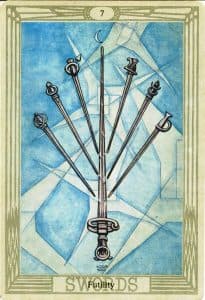
Seven of Swords Overview
The Seven of Swords is the tarot card of strategy, secrecy, avoidance, and hidden motives. It often appears when not everything is being said openly, or when someone is trying to solve a problem indirectly.
After the Six of Swords moves away from conflict toward calmer water, the Seven of Swords asks what happens when the mind becomes tactical again. Sometimes strategy protects a boundary; sometimes it becomes evasion, manipulation, or self-deception.
This card should be read with care. It does not automatically prove betrayal. Its wiser question is: what is being withheld, why is it being withheld, and is secrecy protecting integrity or avoiding accountability?
Read this card in the wider Swords journey
These related guides show how the Seven of Swords develops from earlier Swords themes:
- Ace of Swords: Start here to see how clarity can become a tool for truth or a blade for control.
- Two of Swords: Compare it with guarded silence and decision avoidance.
- Three of Swords: Read this to understand the pain that can make someone hide, defend, or detach.
- Four of Swords: Use this as the restorative pause that helps strategy become wise instead of reactive.
- Five of Swords: Look here for the conflict and power struggle that can lead to secrecy or tactical retreat.
- Six of Swords: Read this to understand the transition away from trouble before strategy becomes necessary again.
- Minor Arcana - Swords: Browse the full suit to see how thought, conflict, recovery, secrecy, and accountability unfold across the Swords sequence.
For a broader comparison, pair it with Six of Swords and Eight of Swords to explore related themes and archetypes.
Historical context and reading frame
In traditional tarot, sevens often describe testing, challenge, and the need to act with discernment. In the Swords suit, that test happens through information, tactics, timing, privacy, and the ethics of what is said or withheld.
A grounded modern reading treats the Seven of Swords as a card of strategy under pressure. It can indicate private planning, selective disclosure, avoidance, secret resentment, workplace politics, self-protection, or dishonest behavior depending on the surrounding cards and real evidence.
Symbolism of the Seven of Swords
In the Rider-Waite-Smith image, a figure carries five swords away while glancing back, leaving two swords behind near a camp. The posture suggests stealth, cleverness, haste, and awareness of being seen.
The image does not give one simple verdict. The figure may be stealing, escaping, reclaiming power, or avoiding direct confrontation. The reader must consider motive, context, and consequence.
- The stolen or carried swords: Ideas, information, leverage, plans, secrets, or tools being taken out of the open.
- The backward glance: Awareness of risk, guilt, caution, or the fear that a hidden action may be discovered.
- The two swords left behind: Unfinished business, missing information, or the limits of a strategy that cannot carry everything.
- The camp: A social group, workplace, family, or relationship system where trust and power are involved.
- The careful step: Tactical movement, secrecy, self-protection, or the temptation to avoid a direct conversation.
Together, these symbols show why the Seven of Swords is morally complex: cleverness may be necessary, but it must answer to truth.
Upright meaning: strategy, secrecy, avoidance, and hidden information
Upright, the Seven of Swords often emphasizes:
- Strategic thinking: A situation may require planning, privacy, timing, and careful choice of what to reveal.
- Secrecy or deception: Something may be hidden, minimized, or handled indirectly, especially where trust is already fragile.
- Avoidance: Someone may be trying to avoid conflict, consequences, vulnerability, or a necessary conversation.
- Self-protection: In some readings, discretion is appropriate because openness would create unnecessary risk.
This card asks for ethical precision. Is the strategy serving safety and wisdom, or is it becoming a way to dodge honesty?
Reversed meaning: confession, exposure, self-honesty, or failed strategy
Reversed, the Seven of Swords often points to:
- Truth coming out: A hidden motive, private plan, or avoided issue may become visible.
- Self-honesty: The card can invite you to stop rationalizing and name what you already know.
- Returning what was taken: Reversed may support repair, disclosure, apology, or restoring trust through accountability.
- Poor strategy: A shortcut, secret plan, or indirect method may fail because it was not built on reality.
Reversed can be a relief if it brings honesty, but it can also be uncomfortable because avoided truths often arrive with consequences.
Seven of Swords in love, work, and personal growth
Love and relationships
Upright: In love, the Seven of Swords can show secrecy, withheld feelings, guarded communication, avoidance, private doubts, or a need for safer honesty.
Reversed: Reversed, it may point to disclosure, rebuilding trust, admitting avoidance, or discovering that assumptions need evidence before accusation.
Work and creative direction
Upright: In work, this card may indicate quiet planning, office politics, intellectual property concerns, strategic timing, or someone acting without full transparency.
Reversed: Reversed, it can suggest exposed shortcuts, improved transparency, documentation, accountability, or the need to bring a private plan into the open.
Personal growth and spiritual practice
Upright: For growth, the card challenges self-deception, secrecy around fear, and the habit of mistaking clever avoidance for freedom.
Reversed: Reversed, it asks whether you are ready to tell yourself the truth and choose a cleaner strategy.
Journal prompts for the Seven of Swords
- What am I not saying openly, and what purpose does that silence serve?
- Where is strategy protecting me, and where is it helping me avoid accountability?
- What evidence do I actually have before assuming hidden motives in someone else?
Working with the Seven of Swords
If you want to work with this card in a grounded way, try these practices:
- Motive check: Before acting privately, pause and ask whether your plan protects safety, ego, fear, or truth.
- Journaling: Write the difference between privacy, secrecy, avoidance, and deception in your current situation.
- Affirmation: I can be strategic without abandoning honesty.
- Evidence and boundaries: Separate intuition from evidence, and choose one clean next step: ask, document, disclose, wait, or set a boundary.
Spiritual significance
Spiritually, the Seven of Swords tests the shadow of intelligence. It asks whether cleverness is serving liberation or whether it has become a mask for fear, shame, or control.
Its lesson is clean strategy. The mind is allowed to be careful, but wisdom does not need to betray truth to stay safe.
Reading boundaries and practical cautions
The Seven of Swords does not prove cheating, theft, betrayal, or malicious intent by itself. Tarot is a reflective tool, not evidence or a substitute for legal, workplace, mental health, or safety support.
If this card appears around serious suspicion, slow down. Gather facts, protect your boundaries, and avoid turning symbolic language into accusation without real-world support.
Conclusion
The Seven of Swords reminds us that strategy is not the enemy. The question is whether the strategy is honest, necessary, and aligned with the person you are trying to become.
When read well, this card helps you move carefully without losing integrity. It asks for intelligence with accountability, privacy without deception, and caution without fear running the whole story.
Continue the Tarot Journey
Related Tarot Cards
Ready to Calculate Your Arcana?
Use Arcana Calculator to find your Major Arcana tarot card by birth date and name. Get personalized numerology insights and spiritual guidance. Calculate yours now!
Calculate now