Nine of Swords - anxiety, guilt, and bringing night fears into daylight
Nine of Swords Overview
The Nine of Swords is the tarot card of anxiety, worry, insomnia, guilt, and the private suffering that grows louder when everything else is quiet. It often appears when the mind is replaying fear at full volume.
After the Eight of Swords shows restriction and a narrowed field of options, the Nine of Swords moves into the inner aftermath: rumination, dread, regret, and thoughts that feel more punishing at night than they do in daylight.
A responsible reading treats this card with care. It does not diagnose a mental health condition or tell someone to simply think positive. It asks what fear is trying to protect, what facts can be checked, and what support would make the burden less solitary.
Read this card in the wider Swords journey
These related guides show how the Nine of Swords develops from earlier Swords themes:
- Ace of Swords: Start here for the clarity that helps separate truth from spiraling thought.
- Two of Swords: Compare it with guarded pause, decision pressure, and emotional shielding.
- Three of Swords: Use this to understand grief, heartbreak, and the honest processing of pain.
- Four of Swords: Read this as the restorative pause that prevents exhaustion from turning into despair.
- Five of Swords: Look here for conflict, harsh words, and the guilt that can follow a hollow victory.
- Six of Swords: Read this to understand recovery and the movement away from turbulence.
- Seven of Swords: Compare this with secrecy, avoidance, and the stress of hidden information.
- Eight of Swords: Use this as the immediate lead-in: restriction, fear, and the belief that there is no way out.
- Minor Arcana - Swords: Browse the full suit to see how thought, truth, conflict, recovery, restriction, anxiety, and release unfold across the Swords sequence.
For a broader comparison, pair it with Eight of Swords and Ten of Swords to explore related themes and archetypes.
Historical context and reading frame
In traditional tarot, nines often describe culmination, intensity, and the point where a pattern becomes difficult to ignore. In the Swords suit, that culmination happens in the mind: worry, memory, conscience, fear, and repeated thought.
A grounded modern reading treats the Nine of Swords as a card of mental distress and perspective distortion under pressure. It can indicate anxiety, insomnia, regret, shame, intrusive worry, or a fear that needs facts, conversation, rest, and support rather than isolation.
Symbolism of the Nine of Swords
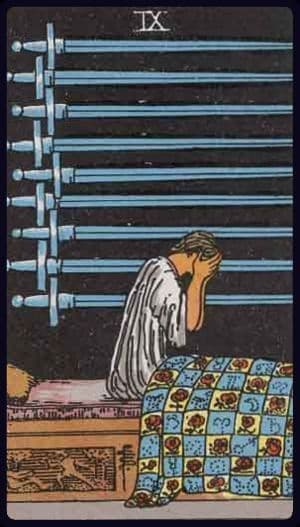
In the Rider-Waite-Smith image, a person sits upright in bed with their face in their hands. Nine swords hang on the dark wall behind them, and the blanket carries intense symbolic imagery.
The scene is private, nocturnal, and psychologically heavy. Nothing external is attacking in the image, yet the suffering is real. That tension is the key to the card: inner experience matters, even when the threat needs careful verification.
- The bed: A place meant for rest becoming a place of mental pressure, insomnia, or emotional replay.
- The nine swords: Repeated thoughts, worries, memories, accusations, or fears lined up in the mind.
- The covered face: Shame, grief, exhaustion, or the feeling of not wanting to meet the day yet.
- The dark room: The way fear can intensify when there is less distraction and less outside perspective.
- The patterned blanket: The body carrying the story too, reminding us that worry is not only intellectual.
Together, these symbols show a painful but important truth: the mind may be suffering, and the first medicine is not denial but compassionate reality-testing.
Upright meaning: anxiety, guilt, rumination, and sleepless fear
Upright, the Nine of Swords often emphasizes:
- Anxiety and worry: The mind may be rehearsing worst-case scenarios, especially when there is uncertainty or emotional exhaustion.
- Guilt or regret: A past action, conversation, or missed chance may be replaying with more punishment than usefulness.
- Insomnia and mental overload: The card can describe thoughts that become louder at night, when the nervous system needs rest but cannot find it.
- Need for support: This is not a card that asks you to carry everything alone. Naming the fear with a trusted person can reduce its power.
The Nine of Swords does not say every fear is false. It says fear needs daylight: facts, proportion, rest, and help from outside the loop.
Reversed meaning: relief, disclosure, or being caught in the spiral
Reversed, the Nine of Swords often points to:
- A burden being named: A worry may finally be spoken, written down, or brought into a conversation where it becomes less absolute.
- Mental relief: The intensity can begin to soften when facts, rest, apology, repair, or support enter the picture.
- Persistent rumination: In some readings, reversed shows the spiral continuing because the mind is still seeking certainty it cannot get.
- Self-forgiveness work: The card may ask for accountability without endless self-punishment.
Reversed is most healing when it turns private suffering into supported processing. The goal is not to erase feeling, but to stop fear from becoming the only narrator.
Nine of Swords in love, work, and personal growth
Love and relationships
Upright: In love, the Nine of Swords can show anxious attachment, fear of loss, guilt after conflict, overanalyzing messages, or lying awake imagining the worst.
Reversed: Reversed, it may point to honest conversation, apology, reassurance, clearer boundaries, or realizing that rumination is not the same as evidence.
Work and creative direction
Upright: In work, this card may indicate performance anxiety, fear of failure, shame after a mistake, burnout, or pressure that follows you into sleep.
Reversed: Reversed, it can suggest asking for feedback, documenting facts, repairing an error, reducing workload, or getting support before worry becomes collapse.
Personal growth and spiritual practice
Upright: For growth, the card highlights the inner critic, catastrophizing, and the need to distinguish conscience from cruelty.
Reversed: Reversed, it asks whether you can let accountability become repair instead of a lifelong sentence.
Journal prompts for the Nine of Swords
- What is the fear saying, and what confirmed facts support or challenge it?
- What would I tell someone I love if they were punishing themselves this way?
- What one action would move this worry from private spiral into practical support?
Working with the Nine of Swords
If you want to work with this card in a grounded way, try these practices:
- Night-to-day list: Write the worry down at night, then review it in daylight and mark facts, guesses, and next actions separately.
- Journaling: Separate guilt from responsibility: what needs repair, what needs release, and what needs support?
- Affirmation: My fear deserves care, but it does not get to be the only voice in the room.
- Support and safety: If worry becomes overwhelming, persistent, or unsafe, reach out to qualified mental health, medical, crisis, or trusted community support.
Spiritual significance
Spiritually, the Nine of Swords asks us to stop confusing suffering with truth. A thought can feel powerful without being wise, accurate, or complete.
Its lesson is compassionate discernment. Bring the fear into the light, listen for what it is protecting, and then let reality, support, and mercy join the conversation.
Reading boundaries and practical cautions
The Nine of Swords does not diagnose anxiety, depression, trauma, insomnia, or any medical or mental health condition. Tarot is a reflective tool, not a substitute for professional care.
If this card reflects severe distress, self-harm thoughts, panic, prolonged insomnia, or a situation where you feel unsafe, prioritize immediate real-world support from qualified professionals, crisis resources, or trusted people.
Conclusion
The Nine of Swords is one of the most emotionally honest cards in the Swords suit. It names the hour when fear feels largest because it is being held alone.
Read well, this card does not shame you for worrying. It helps you bring worry into daylight, check what is real, ask for help, and let the mind stop serving as both prosecutor and prison.
Continue the Tarot Journey
Related Tarot Cards
Ready to Calculate Your Arcana?
Use Arcana Calculator to find your Major Arcana tarot card by birth date and name. Get personalized numerology insights and spiritual guidance. Calculate yours now!
Calculate now