Ten of Swords - painful endings, truth, and the first morning after collapse
Ten of Swords Overview
The Ten of Swords is the tarot card of painful endings, collapse, betrayal, exhaustion, and the moment when denial can no longer protect anyone. It often appears when a pattern has reached its limit and the truth is impossible to negotiate away.
After the Nine of Swords brings anxiety, guilt, and sleepless fear into daylight, the Ten of Swords shows the end point of that pressure: something has broken, finished, or been exposed. The card is dramatic, but its deepest message is not doom. It is finality followed by the first possible morning.
A responsible reading does not use this card to frighten someone. It asks what is truly over, what still needs care, what practical support is required, and how recovery can begin without pretending the pain was small.
Read this card in the wider Swords journey
These related guides show how the Ten of Swords completes earlier Swords themes:
- Ace of Swords: Start here for the clarity that begins the whole Swords sequence.
- Two of Swords: Compare it with indecision, emotional shielding, and the pressure before truth is faced.
- Three of Swords: Use this to understand heartbreak, grief, and honest emotional processing.
- Four of Swords: Read this as the healing pause that can prevent collapse when taken early enough.
- Five of Swords: Look here for conflict, harsh words, and victories that cost too much.
- Six of Swords: Read this for the recovery journey after pain, conflict, or emotional turbulence.
- Seven of Swords: Compare this with secrecy, strategy, and the consequences of hidden information.
- Eight of Swords: Use this to understand restriction, fear, and the belief that there is no way out.
- Nine of Swords: Read this as the immediate lead-in: anxiety, guilt, insomnia, and the mind under pressure.
- Minor Arcana - Swords: Browse the full suit to see how thought, truth, conflict, recovery, restriction, anxiety, ending, and renewal unfold across the Swords sequence.
For a broader comparison, pair it with Nine of Swords and Page of Swords to explore related themes and archetypes.
Historical context and reading frame
In traditional tarot, tens often describe completion, saturation, and the point where a cycle can no longer keep expanding in the same form. In the Swords suit, that completion happens through thought, language, conflict, truth, and the consequences of mental or verbal patterns.
A grounded modern reading treats the Ten of Swords as a card of finality and aftermath. It can indicate betrayal, burnout, defeat, a harsh ending, a painful realization, or a situation that needs honest acceptance before repair, rest, legal care, medical care, or emotional support can begin.
Symbolism of the Ten of Swords
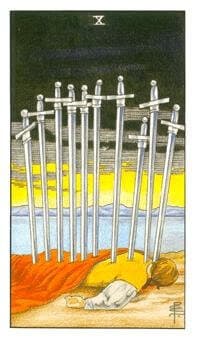
In the Rider-Waite-Smith image, a figure lies face down with ten swords in their back. The sky is black above them, but a strip of yellow light rises on the horizon beyond the water.
The image is severe because the card refuses to soften the fact of an ending. Yet the horizon matters just as much as the swords. The worst point is not the same as the whole future.
- The fallen figure: Exhaustion, defeat, betrayal, or the body finally saying that a painful pattern cannot continue.
- The ten swords: A buildup of thoughts, words, conflicts, facts, or decisions that has reached its limit.
- The dark sky: Shock, grief, despair, or the heavy atmosphere that can surround a difficult ending.
- The yellow horizon: The first sign that the story continues after the collapse, even if hope is still quiet.
- The still water: Emotional reality beneath the mental crisis, asking for calm, support, and time.
Together, these symbols show the central lesson: do not deny the ending, but do not confuse the ending with your entire life.
Upright meaning: painful ending, collapse, betrayal, and release
Upright, the Ten of Swords often emphasizes:
- A final ending: A relationship, plan, belief, role, argument, or pattern may be finished in a way that cannot be undone by more analysis.
- Betrayal or harsh truth: The card can name the pain of being let down, exposed, abandoned, or forced to see what was already happening.
- Burnout and exhaustion: It may show the body and mind reaching the end of endurance after stress, overwork, conflict, or constant vigilance.
- Release through acceptance: The card often asks you to stop arguing with the ending so energy can move toward care, boundaries, and rebuilding.
The Ten of Swords is not subtle, but it is not only tragic. Once something is truly over, the mind can stop negotiating with what already happened and begin asking what support is needed now.
Reversed meaning: recovery, refusing finality, or surviving the worst
Reversed, the Ten of Swords often points to:
- The first recovery: The worst may be passing, and attention can slowly shift from shock to care, repair, and practical next steps.
- Avoiding the ending: In some readings, reversed shows someone trying to revive a pattern that has already shown its limit.
- Survival and perspective: The card can show that you are still here, even after a loss, humiliation, betrayal, or emotional crash.
- Fear of getting up: The nervous system may need time before action feels possible; recovery should be steady, not performative.
Reversed is most useful when it honors both truths: the pain was real, and the next chapter does not have to be built around the wound.
Ten of Swords in love, work, and personal growth
Love and relationships
Upright: In love, the Ten of Swords can show a breakup, betrayal, painful disclosure, emotional exhaustion, or the final recognition that a dynamic cannot continue as it is.
Reversed: Reversed, it may point to post-breakup healing, honest closure, repairing only what is truly repairable, or refusing to keep reopening the same wound.
Work and creative direction
Upright: In work, this card may indicate burnout, a failed project, public criticism, job loss, a broken agreement, or the end of a role that has become unsustainable.
Reversed: Reversed, it can suggest recovering after professional disappointment, documenting what happened, seeking advice, rebuilding capacity, and choosing a clearer path.
Personal growth and spiritual practice
Upright: For growth, the card highlights the story that must end: martyrdom, catastrophic thinking, self-abandonment, or staying loyal to a version of life that keeps hurting you.
Reversed: Reversed, it asks whether you can let survival become wisdom instead of identity.
Journal prompts for the Ten of Swords
- What is genuinely over, and what am I still trying to bargain back into life?
- What support, documentation, rest, or protection do I need before I make another decision?
- If the first morning after this ending were gentle and practical, what would it ask me to do first?
Working with the Ten of Swords
If you want to work with this card in a grounded way, try these practices:
- Ending inventory: Write what ended, what still needs care, what must be protected, and what can wait until you have slept.
- Journaling: Separate facts from the story of total ruin. What happened, what it means, and what is still unknown are not the same list.
- Affirmation: This ending is real, but it is not the whole of me.
- Support and safety: If the ending involves crisis, harm, medical symptoms, legal risk, financial exposure, or unsafe thoughts, prioritize qualified real-world help before treating the card as private reflection.
Spiritual significance
Spiritually, the Ten of Swords teaches the humility of completion. Some doors do not close because we failed; they close because the lesson, structure, or illusion has reached its limit.
Its medicine is honest release. Do not romanticize suffering, and do not rush the sunrise. Let the truth be true, then let care begin.
Reading boundaries and practical cautions
The Ten of Swords does not predict death, prove betrayal, or diagnose trauma, depression, burnout, or any medical or mental health condition. Tarot is a reflective tool, not a substitute for professional advice.
If this card reflects immediate danger, self-harm thoughts, violence, severe distress, legal exposure, financial harm, or medical symptoms, seek qualified emergency, crisis, legal, medical, financial, or trusted community support.
Conclusion
The Ten of Swords is the painful completion of the Swords sequence: the point where thought, conflict, fear, and truth have gone as far as they can in one direction.
Read well, this card does not trap you in disaster. It helps you name the ending clearly, stop feeding what is finished, protect what remains, and begin the slow, honest work of getting up.
Continue the Tarot Journey
Related Tarot Cards
Ready to Calculate Your Arcana?
Use Arcana Calculator to find your Major Arcana tarot card by birth date and name. Get personalized numerology insights and spiritual guidance. Calculate yours now!
Calculate now