Eight of Swords - mental restriction, fear, and the first clear step out
Eight of Swords Overview
The Eight of Swords is the tarot card of feeling trapped, limited, watched, or mentally boxed in. It often appears when a situation feels impossible because fear has narrowed the field of view.
After the Seven of Swords explores secrecy and strategy, the Eight of Swords shows what can happen when the mind turns that pressure inward. The problem may be real, but the sense of having no options is often stronger than the evidence supports.
A careful reading does not blame the person who feels stuck. It asks which limits are external, which are internalized, and what small verified step would restore agency without denying real risk.
Read this card in the wider Swords journey
These related guides show how the Eight of Swords develops from earlier Swords themes:
- Ace of Swords: Start here for the clean perception that can cut through confusion.
- Two of Swords: Compare this with guarded pause, choice pressure, and the fear of seeing too much too soon.
- Three of Swords: Use this to understand the pain that can make the mind protect itself.
- Four of Swords: Read this as the restorative pause that helps fear settle before action.
- Five of Swords: Look here for conflict patterns that can make a person feel cornered.
- Six of Swords: Read this to understand recovery, transition, and the movement toward calmer conditions.
- Seven of Swords: Compare this with secrecy, avoidance, and the ethical use of strategy under pressure.
- Minor Arcana - Swords: Browse the full suit to see how thought, truth, conflict, recovery, strategy, restriction, and release unfold across the Swords sequence.
For a broader comparison, pair it with Seven of Swords and Nine of Swords to explore related themes and archetypes.
Historical context and reading frame
In traditional tarot, eights often describe structure, momentum, and the consequences of repeated patterns. In the Swords suit, that structure appears through beliefs, assumptions, rules, fear, and language.
A grounded modern reading treats the Eight of Swords as a card of constrained perception. It can indicate anxiety, social pressure, unclear rules, fear of consequences, learned helplessness, or a real limitation that needs practical planning rather than panic.
Symbolism of the Eight of Swords
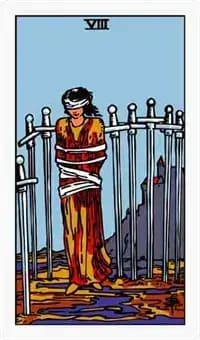
In the Rider-Waite-Smith image, a blindfolded and loosely bound figure stands among eight swords. Water gathers at the feet, a castle sits in the distance, and the ground appears uneven but passable.
The image is uncomfortable because it shows both vulnerability and possibility. The figure is restricted, but not sealed inside a locked room. The card asks what can be moved, named, loosened, or tested.
- The blindfold: Fear, limited information, or a temporary inability to see the whole situation clearly.
- The loose bindings: Restrictions that may feel total but can sometimes be loosened with support, evidence, or one careful action.
- The eight swords: Thought patterns, rules, judgments, threats, or repeated stories that make the path feel narrower.
- The water at the feet: Emotion beneath the thinking mind, especially fear, shame, overwhelm, or grief.
- The distant castle: Safety, perspective, or authority that exists, but may not feel reachable yet.
Together, these symbols show the central lesson: the way out begins by separating real limits from fear-amplified limits.
Upright meaning: restriction, fear, and narrowed perception
Upright, the Eight of Swords often emphasizes:
- Feeling trapped: A person may feel boxed in by consequences, expectations, rules, debt, conflict, secrecy, or fear of making things worse.
- Mental restriction: The mind may repeat the same story until every option appears unsafe, impossible, or already lost.
- Internalized limits: Past criticism, social pressure, or old survival patterns may be shaping the present more than the facts do.
- Need for a small step: The card usually asks for one specific, testable action rather than a dramatic escape.
This card is not a sentence. It is a diagnostic moment: name the constraint, check the evidence, and look for the smallest door that is actually available.
Reversed meaning: release, clearer sight, or refusing help
Reversed, the Eight of Swords often points to:
- Regaining agency: A person may begin to see options, ask for help, set a boundary, or take a practical step out of a limiting pattern.
- Truth becoming visible: The blindfold may loosen as facts, conversations, or self-honesty replace assumption.
- Fear losing authority: The situation may still be difficult, but fear no longer gets to define the whole map.
- Staying stuck by habit: In some readings, reversed can show resistance to freedom because the familiar cage feels safer than change.
Reversed is most helpful when it turns insight into motion. Seeing the door matters; walking toward it matters too.
Eight of Swords in love, work, and personal growth
Love and relationships
Upright: In love, the Eight of Swords can show feeling unable to speak, fear of rejection, emotional pressure, overthinking, or a relationship dynamic where someone feels cornered.
Reversed: Reversed, it may point to clearer communication, leaving a fear loop, naming a boundary, or recognizing that silence has become part of the problem.
Work and creative direction
Upright: In work, this card may indicate unclear authority, limiting beliefs, fear of consequences, workplace pressure, or a project stalled by overanalysis.
Reversed: Reversed, it can suggest documenting facts, asking for clarification, finding an advocate, or taking one manageable step that restores momentum.
Personal growth and spiritual practice
Upright: For growth, the card highlights the stories that make freedom feel impossible and the protective habits that now need updating.
Reversed: Reversed, it asks whether you are ready to trade helplessness for responsibility, support, and a realistic next step.
Journal prompts for the Eight of Swords
- Which part of this situation is a confirmed fact, and which part is fear filling in the blanks?
- What is one small action that would give me more information without requiring a final decision?
- Where have I mistaken familiar fear for proof that I have no options?
Working with the Eight of Swords
If you want to work with this card in a grounded way, try these practices:
- Reality check: Write three facts, three fears, and one question you can verify today.
- Journaling: Draw the cage: label each sword as a rule, belief, person, consequence, or assumption.
- Affirmation: I do not need to solve everything at once to take one honest step.
- Support and safety: If the limitation involves harm, coercion, legal risk, or mental health crisis, use real-world support before treating the card as personal homework.
Spiritual significance
Spiritually, the Eight of Swords teaches discernment between humility and helplessness. It asks the mind to stop treating fear as an oracle.
Its medicine is agency with compassion: do not shame yourself for being afraid, but do not let fear become the only voice allowed to speak.
Reading boundaries and practical cautions
The Eight of Swords does not prove that you are powerless, trapped forever, or responsible for every limitation around you. Tarot is a reflective tool, not a substitute for legal, medical, financial, workplace, or safety advice.
If you feel unsafe, controlled, or mentally overwhelmed, prioritize qualified support, trusted people, and practical safety planning. The card can support reflection, but real conditions deserve real help.
Conclusion
The Eight of Swords is a difficult card, but it is not a hopeless one. It names the moment when fear has become architecture around the mind.
Read well, this card helps you loosen the blindfold without denying reality. One clear fact, one honest conversation, and one small step can begin to restore movement.
Continue the Tarot Journey
Related Tarot Cards
Ready to Calculate Your Arcana?
Use Arcana Calculator to find your Major Arcana tarot card by birth date and name. Get personalized numerology insights and spiritual guidance. Calculate yours now!
Calculate now