King of Swords - intellectual authority, fair judgment, and ethical leadership
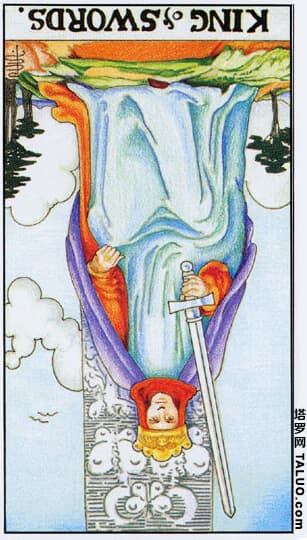
King of Swords Overview
The King of Swords is the court card of intellectual authority, rational judgment, strategic thinking, and the ethical use of truth. After the Queen of Swords develops mature discernment, the King applies that clarity to decisions, systems, leadership, and consequences.
This card often appears when a situation needs evidence, expertise, consistent standards, or a decision that can be explained and defended. It may describe a person, a leadership role, or the part of you capable of separating relevant facts from pressure and noise.
A responsible reading does not treat the King as automatically correct or emotionally superior. His best expression joins logic with fairness, accountability, context, and the humility to revise a conclusion when better information appears.
Read this card in the complete Swords journey
These related guides show the experiences and skills that culminate in the King of Swords:
- Ace of Swords: Begin with the insight and truth that give the suit its intellectual standard.
- Two of Swords: Compare authority with the pause required when evidence or priorities conflict.
- Three of Swords: Remember that even a sound decision can carry emotional consequences.
- Four of Swords: Read this as the mental recovery that protects judgment from exhaustion.
- Five of Swords: Use this to distinguish principled leadership from winning at any cost.
- Six of Swords: Explore how wise direction supports a necessary transition.
- Seven of Swords: Compare strategic intelligence with secrecy, avoidance, or manipulation.
- Eight of Swords: See how clear analysis can challenge assumptions that feel like fixed limits.
- Nine of Swords: Read this for the fear and rumination that evidence-based thinking can help contain.
- Ten of Swords: Understand the ending or failure from which stronger systems may be built.
- Page of Swords: Return to curiosity, questions, and the gathering of reliable information.
- Knight of Swords: Compare disciplined strategy with fast action, conviction, and haste.
- Queen of Swords: Read the direct lead-in: mature discernment and boundaries before public authority.
- Minor Arcana - Swords: Browse all fourteen cards to follow the Swords themes of thought, conflict, recovery, truth, communication, and responsibility from beginning to mastery.
For a broader comparison, pair it with Queen of Swords to explore related themes and archetypes.
Historical context and reading frame
In traditional tarot, Kings commonly represent developed command of a suit and the outward responsibility that comes with it. In Swords, this can include reason, language, law, strategy, standards, institutions, and decisions that affect other people.
Some modern esoteric systems call the King of Swords Air of Air, emphasizing concentrated intellect and communication. This correspondence is a reading tradition rather than an objective fact, and different decks may frame the card’s elemental role differently.
Symbolism of the King of Swords
In the Rider-Waite-Smith image, the King faces forward on a stone throne and holds an upright sword. His direct gaze, elevated seat, blue clothing, shifting clouds, and distant trees create a scene of alertness, command, and mental perspective.
The image suggests authority under examination. The King is visibly responsible for the sword he holds: intellect can clarify and protect, but it can also become rigid or punitive when power is separated from ethics.
- The upright sword: Truth, law, precise reasoning, direct communication, and the power to decide.
- The forward-facing posture: Readiness to examine facts directly and accept public accountability for a judgment.
- The stone throne: Stable authority, institutions, established standards, and the risk of inflexibility.
- The blue robe and mantle: Composure, mental depth, restraint, and the expectation that power be exercised deliberately.
- Clouds and distant trees: Changing information within a wider perspective, and the living consequences beyond abstract logic.
Together, these symbols present mastery as responsibility. The King’s intelligence matters most when it produces decisions that are clear, proportionate, transparent, and fair.
Upright meaning: authority, logic, strategy, and fair judgment
Upright, the King of Swords often emphasizes:
- Intellectual authority: Using knowledge, expertise, and careful reasoning to understand a complex situation.
- Fair judgment: Applying consistent standards while considering evidence, context, impact, and due process.
- Strategic leadership: Setting direction, defining responsibilities, and turning a clear principle into a workable plan.
- Truth with accountability: Explaining how a conclusion was reached and remaining answerable for its consequences.
At his best, the King of Swords supports decisions that can withstand scrutiny. He asks for enough distance to think clearly, but not so much distance that people become data points and human impact disappears.
Reversed meaning: rigidity, misuse of power, manipulation, or poor judgment
Reversed, the King of Swords often points to:
- Rigid thinking: Treating one framework, rule, or conclusion as complete when the situation requires context or revision.
- Misused authority: Using status, expertise, policy, or language to dominate rather than clarify and protect.
- Strategic manipulation: Selecting facts, withholding context, or framing an argument to control the outcome.
- Detached judgment: Making an efficient decision that ignores fairness, emotional reality, or foreseeable harm.
A reversed King does not prove that a leader is corrupt or that your reasoning is wrong. It is a prompt to verify sources, disclose conflicts, invite qualified challenge, and check whether power is serving the stated principle.
King of Swords in love, work, and personal growth
Love and relationships
Upright: In love, the King can support direct conversations, explicit agreements, mature problem-solving, and decisions based on both shared values and observable behavior.
Reversed: Reversed, it may indicate controlling communication, emotional dismissal, inflexible rules, intellectual one-upmanship, or a relationship being managed instead of mutually understood.
Work and creative direction
Upright: At work, this card favors research, law, policy, analysis, engineering, editing, consulting, negotiation, governance, and leadership that uses clear criteria and documented reasoning.
Reversed: Reversed, it can flag opaque decisions, authoritarian management, selective evidence, impossible standards, poor governance, or expertise used to silence legitimate questions.
Personal growth and spiritual practice
Upright: For growth, the King asks you to build a reliable method: seek good sources, test assumptions, explain your reasoning, and align decisions with your principles.
Reversed: Reversed, consider whether certainty has become armor, whether a rule has outlived its purpose, or whether being right has become more important than learning.
Journal prompts for the King of Swords
- What decision needs clearer criteria, stronger evidence, or qualified expertise?
- Where do I hold authority, and how can I make its use more transparent and fair?
- What information would genuinely change my conclusion?
Working with the King of Swords
Use these grounded practices to engage the card’s clarity without confusing symbolic insight with certainty:
- Council-table pause: Imagine placing the facts, affected people, risks, principles, and unknowns around one table before choosing a direction.
- Decision record: Write the question, known evidence, assumptions, alternatives, likely impacts, and the condition that would trigger a review.
- Affirmation: I use clarity with humility, authority with accountability, and truth in service of fairness.
- Decision-making: For legal, medical, financial, safety, employment, or mental health matters, use qualified professional guidance and verifiable evidence; tarot can support reflection but cannot establish facts or outcomes.
Spiritual significance
Spiritually, the King of Swords presents discernment as a form of stewardship. Knowledge carries an obligation: to question carefully, communicate honestly, and consider how a decision affects those with less power.
His lesson is not perfect certainty. It is disciplined integrity: hold a clear standard, remain open to correction, and make the use of truth as ethical as the truth you defend.
Reading boundaries and practical cautions
The King of Swords does not prove that someone is a judge, lawyer, executive, expert, manipulator, or authoritarian, and it cannot verify motives, guilt, contracts, diagnoses, or future outcomes. Tarot is a reflective practice, not evidence or professional advice.
When a question involves legal rights, medical symptoms, financial exposure, workplace action, coercion, abuse, or immediate safety, prioritize qualified support, reliable records, and direct real-world assessment over a card interpretation.
Conclusion
The King of Swords completes the suit’s court sequence by turning curiosity, action, and discernment into accountable authority. His strength is not intellect alone, but the disciplined use of intellect in decisions that matter.
Read thoughtfully, this card asks you to become more rigorous and more responsible at once: gather sound evidence, state your reasoning, protect fairness, and stay willing to revise what you think you know.
Continue the Tarot Journey
Related Tarot Cards
Ready to Calculate Your Arcana?
Use Arcana Calculator to find your Major Arcana tarot card by birth date and name. Get personalized numerology insights and spiritual guidance. Calculate yours now!
Calculate now