How Arcana Numbers Are Calculated: Major Arcana Numbering Explained
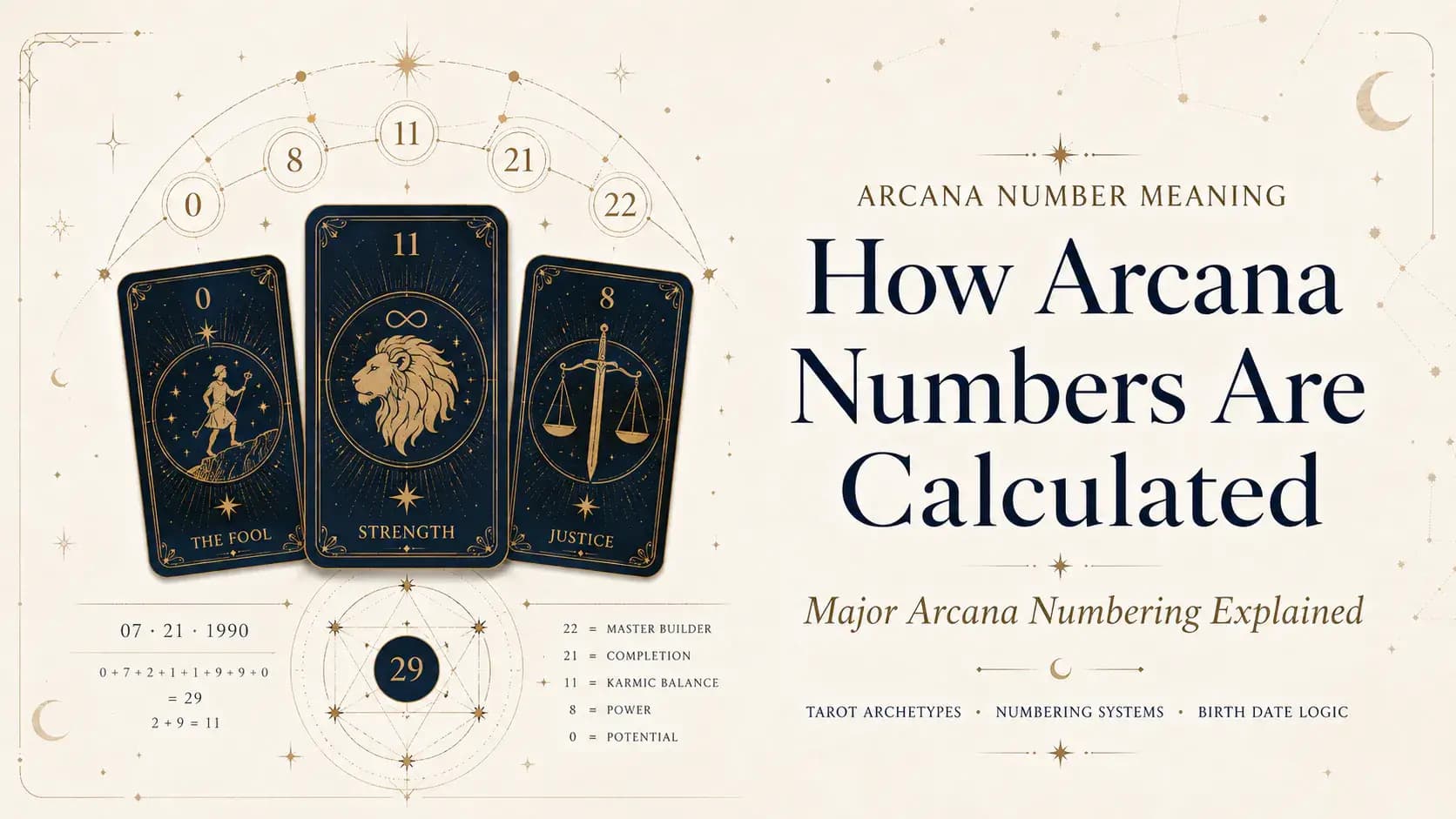
If you have used more than one Arcana Calculator, you may have noticed something confusing: the same birth date does not always lead to the same result.
One calculator may give you The Hierophant. Another may give you Temperance.
One system may treat The Fool as 0, while another places it at 22. Strength and Justice may also switch positions depending on the tarot tradition being used.
This does not always mean a calculator is wrong. More often, it means the calculator is following a different numbering system.
This guide explains how Arcana Numbers are usually calculated, how they connect to Major Arcana cards, and why different methods can sometimes produce different results.
What Is an Arcana Number?
An Arcana Number is a number used to connect a birth date with a Major Arcana card.
It is not exactly the same as a lucky number or a general numerology number. In an Arcana system, the number works as a bridge. It takes the numbers from your birth date and uses them to find a corresponding tarot archetype in the Major Arcana.
For example, if your final Arcana Number is 5, many systems will connect that number with The Hierophant. But the meaning does not stop at the number 5. The real interpretation comes from the card itself: its symbols, themes, lessons, and archetypal meaning.
That distinction matters. An Arcana Number is useful because it points to a tarot card. The card carries the deeper meaning.
If you are still new to the broader idea, you may want to read about what Arcana means in tarot before focusing on the calculation method.
Why Major Arcana Numbering Matters
The Major Arcana is a set of 22 tarot cards. Each card has a name, image, number, and symbolic role within the tarot sequence.
That numbered structure is what makes Arcana Number calculation possible. A birth date can be reduced into a number, and that number can then be matched with a Major Arcana card.
At first, this sounds simple. The difficulty is that not every tarot system numbers the cards in exactly the same way.
Most modern readers are familiar with the Rider-Waite-Smith order, where The Fool is 0, Strength is 8, Justice is 11, and The World is 21. But other traditions may organize the sequence differently. Some calculation systems also prefer a 1-22 structure, where The Fool is treated as 22 instead of 0.
So when people ask why two calculators give different results, the answer is often hidden in the numbering system.
To study the cards themselves, you can explore the full Arcana Cards guide.
How Arcana Numbers Are Usually Calculated
Most Arcana Number calculators begin with a birth date. The digits are added together and then reduced until the result can be matched with the Major Arcana.
Here is a simple example.
Suppose the birth date is July 18, 1996.
Written as numbers:
07 / 18 / 1996
Add every digit:
0 + 7 + 1 + 8 + 1 + 9 + 9 + 6 = 41
Since 41 is outside the Major Arcana range, reduce it again:
4 + 1 = 5
In many systems, the final number 5 corresponds with The Hierophant.
This is the basic calculation pattern: birth date, digit addition, reduction, card matching. But the exact result can still depend on how the system treats numbers such as 0, 21, 22, 8, and 11.
That is where most confusion begins.
The Fool: 0 or 22?
The Fool is the first card that can create different Arcana Number results.
In many modern tarot decks, The Fool is numbered 0. Symbolically, this makes sense. The Fool stands before the journey has fully begun. It represents openness, risk, innocence, freedom, and the first step into the unknown.
But some Arcana calculation systems treat The Fool as 22. This also has its own logic. If a calculator wants every Major Arcana card to fit into a 1-22 system, The Fool needs a position inside that range. In that case, 22 can represent both completion and return to the beginning.
Neither approach is automatically wrong. They simply reflect two different ways to organize the tarot sequence.
If a calculator uses The Fool as 0, then 0-based results and reductions may be handled one way. If it uses The Fool as 22, then the final matching table may look different.
This is one of the most common reasons two Arcana tools may not agree.
Strength and Justice: 8 or 11?
Strength and Justice are another source of difference.
In the Rider-Waite-Smith tradition, Strength is usually card 8 and Justice is card 11. This is the order many modern tarot readers recognize.
In some older or alternative traditions, Justice is 8 and Strength is 11.
This matters because the two cards are very different in meaning.
Strength is usually connected with patience, compassion, inner courage, emotional control, and quiet resilience. It is not only about force. It is about the kind of power that can remain calm under pressure.
Justice is more connected with truth, balance, responsibility, fairness, consequences, and clear judgment. It asks for honesty and alignment between action and outcome.
So if your final Arcana Number is 8 or 11, the calculator's chosen tarot order can change your result. One system may give you Strength. Another may give you Justice.
This does not mean your result is meaningless. It means you should understand which card order the calculator is using.
Different Reduction Methods Can Also Change the Result
Card numbering is not the only variable. The calculation method itself can also vary.
Some systems add every digit in the full birth date. Others add the month, day, and year as separate numbers first. Some reduce the result immediately. Others keep compound numbers for interpretation before reducing them into the Major Arcana range.
For many birth dates, these methods may still lead to the same card. But not always.
For example, one method might reduce the full date digit by digit. Another might first add the month, day, and year as larger units. Depending on the date, those two approaches may produce different intermediate totals.
This is why a good Arcana Calculator should not only give a result, but also make the logic understandable enough that users know how the card was found.
Is One Arcana Number Method More Correct?
There is no single universal Arcana Number method accepted by every tarot reader, numerology system, or spiritual tradition.
That may sound frustrating, but it is also part of how symbolic systems work. Tarot has always had multiple traditions, deck structures, and interpretive styles. The important thing is not whether every method produces the same result, but whether the method is consistent and clearly explained.
A reliable Arcana Number system should do three things:
It should use a clear birth date calculation method.
It should explain how the final number is reduced.
It should show which Major Arcana numbering order it follows.
If those three things are clear, the result becomes easier to understand, even if another system uses a slightly different method.
What Your Arcana Number Really Tells You
An Arcana Number should not be treated as a final personality verdict.
The number is only the starting point. It leads you to a Major Arcana card, and that card gives you a symbolic theme to explore.
For example, if your number leads to The Hermit, the useful question is not simply “Am I a Hermit?” A better question is: where do themes of solitude, study, reflection, or inner guidance appear in my life?
If your number leads to The Chariot, the question might be: where do I need more focus, discipline, direction, or emotional control?
If your number leads to The Star, the question might be: where am I being asked to heal, hope, or trust again after difficulty?
That is the real value of an Arcana Number. It gives you a card to think with.
Arcana Number vs Personal Arcana Card
Arcana Number and personal Arcana card are closely related, but they are not exactly the same thing.
The Arcana Number is the calculated number.
The personal Arcana card is the Major Arcana card connected to that number.
For example, if your calculation leads to 5, then 5 is your Arcana Number. If your system matches 5 with The Hierophant, then The Hierophant is your personal Arcana card.
This distinction is useful because people often search for the meaning of the number alone. But in tarot-based Arcana systems, the card is usually more important than the number by itself.
If you want a more beginner-friendly guide to finding your card from your date of birth, you can read about how to find your personal Arcana card by birth date.
Arcana Number vs Life Path Number
Arcana Number and Life Path Number are also easy to confuse because both may use your birth date.
A Life Path Number belongs to numerology. It usually reduces your birth date into a number such as 1 through 9, sometimes with master numbers like 11, 22, or 33. The interpretation focuses mainly on the number.
An Arcana Number is different because it is connected to tarot. The goal is not just to interpret a number, but to match that number with a Major Arcana card.
For example, in numerology, the number 5 may be associated with freedom, change, movement, and adaptability. In an Arcana system, 5 may point to The Hierophant, which brings in themes of teaching, belief, tradition, guidance, and inherited wisdom.
Both systems may be interesting, but they should not be collapsed into the same thing.
Why Calculation Transparency Matters
When a tarot tool gives you a result without showing its logic, the experience can feel random. You receive a card, but you do not know how it was chosen.
For a simple reading, that may be fine. But for an Arcana Number, the calculation is part of the meaning. The user deserves to know whether the system uses The Fool as 0 or 22, how it handles numbers above 22, and which card order it follows.
This is especially important for people who compare results across different tools. Without understanding the method, a different result can feel like an error. With the method explained, the difference becomes easier to interpret.
A transparent calculator does not need to overwhelm the user with theory. But it should make the main logic clear enough that the result feels grounded.
How to Find Your Arcana Number
The simplest way to find your Arcana Number is to use an Arcana Calculator. Enter your birth date, and the tool will calculate your number and match it with a Major Arcana card.
This is faster than calculating manually, and it helps avoid confusion around The Fool, Strength, Justice, and reduction methods.
Once you have your result, do not stop at the number. Read the card. Look at its themes, symbols, strengths, and challenges. Then ask how that archetype may appear in your own life.
That is where the calculation becomes useful.
Final Thoughts
Arcana Numbers are not difficult to calculate, but they can be easy to misunderstand.
The number itself is not the full meaning. It is a path into the Major Arcana. The card behind the number carries the archetype, and the archetype gives you something to reflect on.
Different calculators may give different results because they use different card numbering systems or reduction methods. The Fool may be treated as 0 or 22. Strength and Justice may appear as 8 or 11. Some systems reduce birth dates differently.
Instead of seeing those differences as a problem, it is better to understand the method behind the result.
Start with the Arcana Calculator to find your Arcana Number, then explore the Major Arcana card connected to your birth date.