Major Arcana Explained: 22 Cards, Life Lessons, and the Fool's Journey
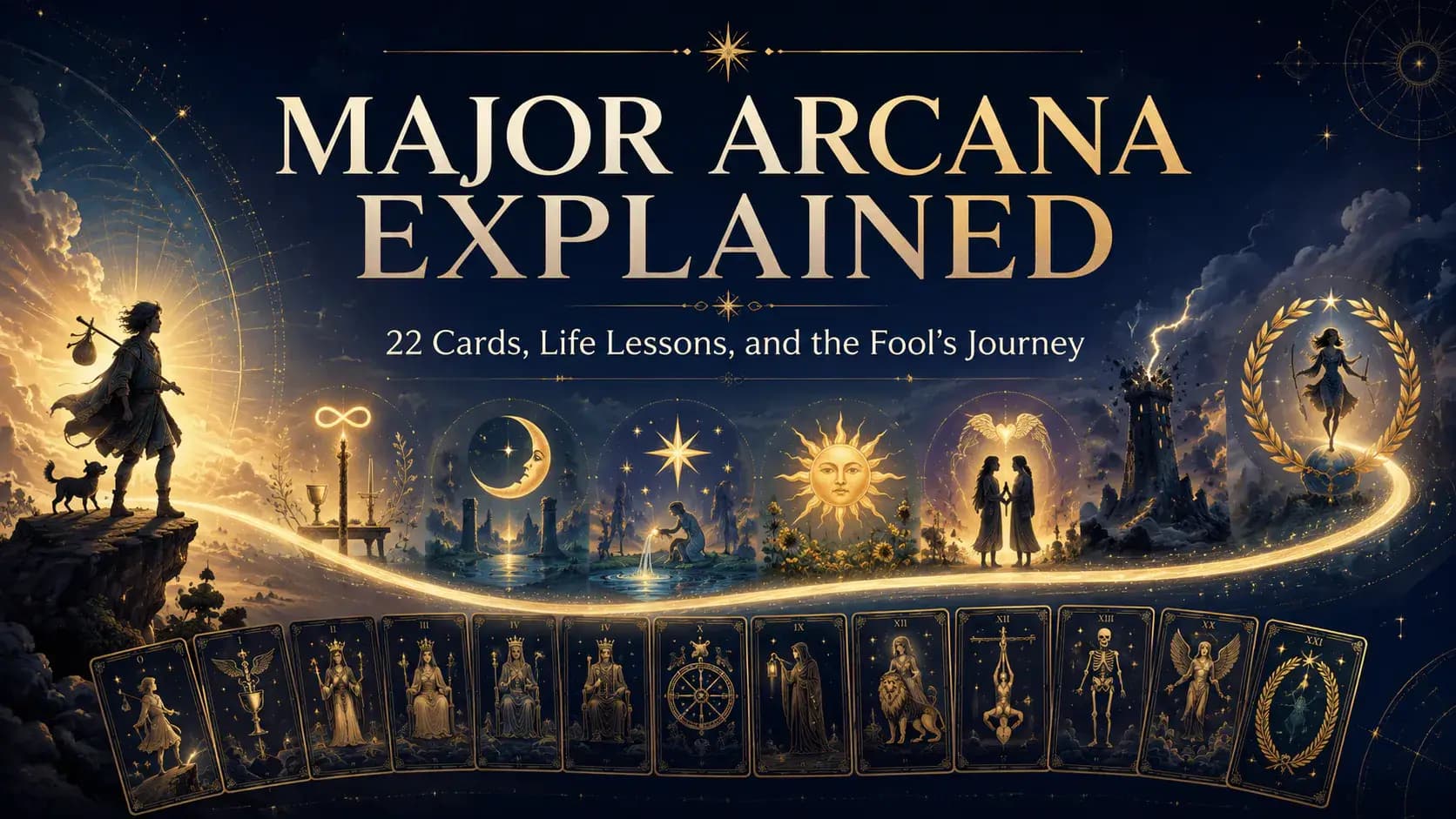
The Major Arcana is the part of tarot that feels the most symbolic. These 22 cards do not only describe daily situations. They point to turning points, emotional patterns, life lessons, and deeper stages of personal growth.
Cards like The Fool, The Lovers, Death, The Tower, The Star, and The World feel powerful because they speak in archetypes. They show the kind of experiences that shape who we become: beginning again, making choices, losing control, healing, awakening, and completing a cycle.
In this guide, we will explain the Major Arcana through the Fool's Journey — a symbolic path from innocence to experience, from uncertainty to awareness, and from beginning to completion.
If you want to know which Major Arcana card is connected to your own birth date, you can calculate your Personal Arcana card with Arcana Calculator.
What Is the Major Arcana?
The Major Arcana is a group of 22 cards in a traditional tarot deck, starting with The Fool and ending with The World. Each card represents a major archetype, theme, or life lesson.
The Minor Arcana often reflects everyday experiences: emotions, work, choices, communication, conflict, and practical situations. The Major Arcana usually speaks to something larger. It may reflect identity, purpose, fear, transformation, awakening, or a recurring pattern in life.
This is why a Major Arcana card can feel personal. It does not simply say, “This may happen.” It often asks, “What are you learning from this?”
Why the Major Arcana Matters
The word “arcana” means hidden knowledge or mystery. In tarot, the Major Arcana represents the deeper symbolic layer of the deck.
A Major Arcana card can point to:
- A life lesson
- A personal archetype
- A turning point
- A recurring pattern
- A spiritual or emotional challenge
- A stage in the Fool's Journey
For example, The Tower is not only about chaos. It can represent the collapse of something false. The Hermit is not only about being alone. It can represent the need to step away from noise and listen inward. The Lovers is not only about romance. It can represent choice, values, and emotional alignment.
If you want a simple reference list first, you can see the full Major Arcana cards in order before returning to this guide.
The Fool's Journey: A Simple Way to Understand the Major Arcana
The Fool's Journey treats the 22 Major Arcana cards as a symbolic story. The Fool begins as an open traveler stepping into the unknown. Along the way, the Fool meets teachers, choices, tests, losses, awakenings, and transformations. By the time the journey reaches The World, a cycle has been completed.
This does not mean everyone experiences life in exactly this order. The Fool's Journey is a map, not a rulebook. At different moments, you may feel like The Fool beginning again, The Hermit searching inward, Death releasing an old identity, or The Star finding hope after difficulty.
The journey can be understood in three broad stages:
- Entering the world and forming identity
- Facing inner tests and transformation
- Moving through shadow, healing, and completion
Stage One: From The Fool to The Chariot — Entering the World
The first stage of the Major Arcana is about beginning, learning, identity, structure, desire, and direction. These cards show how the Fool first encounters the world.
- The Fool is the lesson of beginning. It reminds us that some paths only reveal themselves after we take the first step.
- The Magician is the lesson of personal power. It asks how you are using your attention, skills, and will.
- The High Priestess is the lesson of inner knowing. It teaches that not every truth arrives through logic.
- The Empress is the lesson of nurturing. Growth needs patience, care, beauty, and emotional safety.
- The Emperor is the lesson of structure. Freedom becomes stronger when it has boundaries and foundations.
- The Hierophant is the lesson of tradition and meaning. It asks what you have inherited, what you believe, and what you may need to question.
- The Lovers is the lesson of choice and alignment. It is not only about romance, but about whether your choices match your values.
- The Chariot is the lesson of direction. It teaches focused movement even when your emotions or circumstances pull in different directions.
Stage Two: From Strength to Temperance — Inner Tests and Transformation
The second stage turns inward. These cards deal with courage, solitude, change, responsibility, surrender, endings, and healing.
- Strength is the lesson of gentle power. Real strength is not always force; sometimes it is patience, compassion, and self-control.
- The Hermit is the lesson of solitude. Some answers can only be heard when you step away from noise.
- Wheel of Fortune is the lesson of change. Life moves in cycles, and not everything can be controlled.
- Justice is the lesson of responsibility. Choices have consequences, and truth asks for honesty.
- The Hanged Man is the lesson of surrender. Sometimes the pause you resist becomes the perspective you need.
- Death is the lesson of release. It marks the ending of an old pattern, identity, or phase so something more honest can begin.
- Temperance is the lesson of integration. After change, healing requires balance, patience, and time.
Stage Three: From The Devil to The World — Shadow, Awakening, and Completion
The final stage of the Major Arcana moves through attachment, collapse, hope, uncertainty, clarity, awakening, and wholeness.
- The Devil is the lesson of attachment. It asks where fear, desire, shame, or habit has limited your freedom.
- The Tower is the lesson of collapse. What is not built on truth may eventually fall, but that fall can create space for honesty.
- The Star is the lesson of hope. After disruption, healing often returns quietly and slowly.
- The Moon is the lesson of uncertainty. It teaches emotional honesty when the path is unclear.
- The Sun is the lesson of clarity. It brings warmth, truth, confidence, and the relief of being able to see clearly.
- Judgement is the lesson of awakening. It asks you to review the past without staying trapped inside it.
- The World is the lesson of completion. It represents integration, fulfillment, and the closing of one cycle before another begins.
How Major Arcana Connects to Your Personal Arcana Card
Your Personal Arcana card is usually calculated from your birth date and connected to one or more Major Arcana cards. While a daily tarot reading may reflect a temporary situation, a Personal Arcana card is often interpreted as a deeper life theme or core archetype.
This does not mean one card defines your entire personality. A tarot archetype is not a box. It is more like a symbolic mirror. It can help you notice patterns, strengths, challenges, and lessons that may repeat across different parts of life.
For example, someone connected with The Hermit may often return to themes of solitude, study, and inner guidance. Someone connected with The Lovers may face repeated lessons around choice, relationships, and values. Someone connected with The Tower may experience strong phases of change, disruption, and rebuilding.
To find your own card, you can calculate your Personal Arcana card and see which archetype is connected to your birth date.
How to Use Major Arcana for Self-Reflection
You do not need to treat the Major Arcana as a fixed prediction system. These cards are most useful when they help you ask better questions.
Instead of asking only, “What will happen?” you might ask:
- What lesson is this situation asking me to learn?
- Which pattern am I repeating?
- What part of this card feels familiar in my life?
- What strength does this archetype remind me to use?
- What shadow side does this card reveal?
This is especially helpful when working with your Personal Arcana card or year card.
A birth card may describe a long-term archetype, while a year card can reflect the theme of a specific year.
If you want to explore the theme of your current year, you can calculate your year card and compare it with your Personal Arcana card.
Major Arcana Is More Than a List of Meanings
Many beginners first learn tarot by memorizing keywords. That is useful, but it is only the beginning.
The Major Arcana becomes more meaningful when you understand the relationship between the cards. The Fool is not separate from The World. The Tower is not separate from The Star. Death is not separate from Temperance. Each card has a place in a larger symbolic journey.
When you look at the Major Arcana this way, each card becomes more than a definition. It becomes a lesson.
Final Thoughts
The Major Arcana gives symbolic language to the experiences that shape us most: beginnings, choices, fear, love, solitude, endings, healing, awakening, and completion.
When you understand the 22 Major Arcana cards as life lessons, tarot becomes more than a list of meanings. It becomes a mirror for personal growth.
The Fool's Journey reminds us that every stage has something to teach. Some cards bring clarity. Some bring discomfort. Some ask us to release what no longer fits. Others remind us that hope, joy, and completion are also part of the path.
If you want to see which Major Arcana archetype is connected to your own birth date, start by using the Arcana Calculator to discover your Personal Arcana card.