How Tarot Creators Can Turn Card Meanings Into Audio Stories
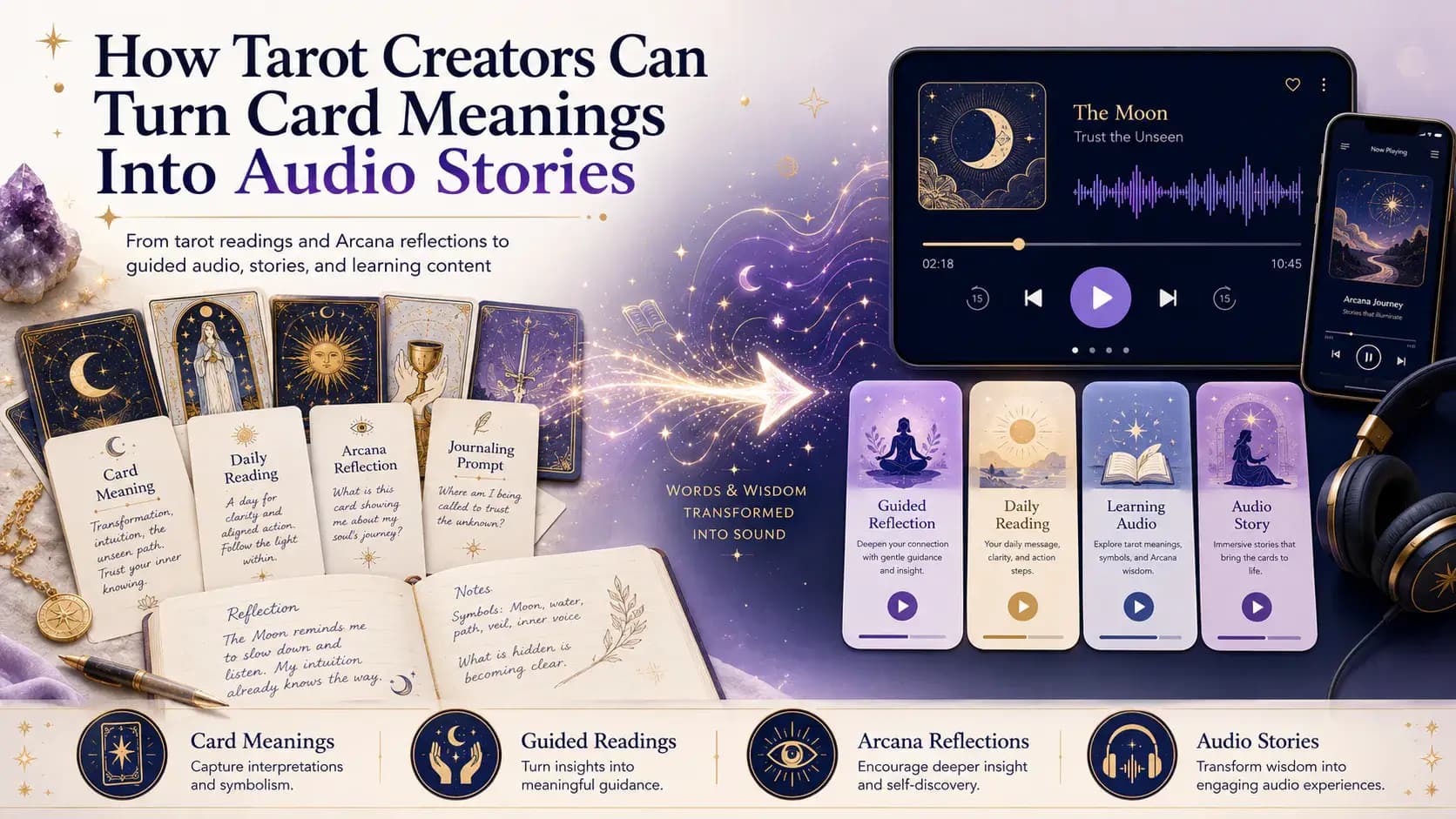
Tarot has always been more than a deck of cards.
Each card carries symbols, moods, archetypes, conflicts, questions, and emotional movement. The Fool begins a journey. The Magician gathers intention. The Tower breaks what can no longer stand. The World brings integration and completion.
That is why tarot content naturally lends itself to storytelling.
Most tarot creators already write a lot of text: card meanings, daily readings, spread interpretations, birth card notes, Arcana reflections, journaling prompts, meditation scripts, and social captions. These materials usually appear as blog posts, newsletters, short-form captions, or reading notes.
But they do not have to stay on the page.
With the right structure, tarot writing can become guided audio, reflective stories, meditation-style readings, podcast segments, learning materials, or audiobook-style narration.
This article explores how tarot creators can turn card meanings and symbolic interpretations into audio stories that feel clear, reflective, and listenable.
Why Tarot Works Well as Audio
Tarot works well as audio because it is already built around images and meaning.
A tarot card is not just a definition. It is a scene. It gives the reader something to enter: a figure, a gesture, a landscape, an object, a direction of movement, or a moment of tension.
When someone reads about a card, they are usually not only looking for information. They are looking for recognition.
They may be asking:
- What does this card reflect in my life?
- What pattern am I repeating?
- What should I pay attention to?
- What is this moment asking of me?
How can I understand this symbol without reducing it to a simple prediction? Audio can support this kind of reflection because listening is intimate. A written explanation gives information, but a spoken interpretation can create atmosphere, pacing, and emotional space.
This is especially useful for Major Arcana content. The Major Arcana are archetypal by nature. They describe thresholds, crises, awakenings, choices, initiations, endings, and transformations. A page can explain these themes, but audio can help the listener feel the movement of the archetype.
For example, reading about The Hermit is useful. But hearing a slow, reflective narration about solitude, inner clarity, and withdrawal from noise can create a different kind of experience.
That is where tarot audio becomes interesting.
Text Assets Tarot Creators Already Have
Many tarot creators already have the raw material needed for audio content. They may not need to start from scratch.
Common tarot text assets include:
- card meaning notes
- daily card readings
- three-card spread interpretations
- Major Arcana explanations
- birth card or Arcana number reflections
- year card interpretations
- journaling prompts
- meditation scripts
- symbolic image descriptions
- newsletter reflections
- social media captions
- beginner tarot lessons
- personal reading scripts
For example, a creator might use Arcana Calculator to explore a personal Major Arcana connection, then write a short reflection about what that card represents in someone’s life path.
Another creator might browse Arcana Cards to study individual card meanings and turn those notes into a beginner-friendly audio lesson.
Someone making visual tarot content might use an AI Tarot Card Generator to create personalized symbolic imagery, then write a spoken explanation of the card's mood, colors, figures, and emotional theme.
All of these written materials can become audio if they are reshaped for listening. The important word is reshaped.
Text written for reading does not always work as audio.
What Tarot Writing Can Become
Once tarot creators begin thinking of text as an audio asset, several formats become possible.
1. Daily card audio readings
A daily card reading does not have to be only a written post.
It can become a short audio reflection:
Today’s card is Strength. This is not only about force or control. It asks where gentleness may be more powerful than pressure.
A daily audio reading can be used for newsletters, podcasts, social media, meditation apps, private communities, or personal journaling routines.
The format works best when it is short, focused, and reflective.
A good daily card audio usually includes:
- the card name
- a brief image or symbol
- the core theme
- one real-life interpretation
- one reflection question
2. Guided Arcana reflections
Major Arcana cards are especially suitable for guided reflections.
Instead of explaining the card like a dictionary entry, a creator can guide the listener through the card’s symbolic landscape.
For example, a guided reflection on The Fool might begin with the image of standing at the edge of a path. A reflection on The Tower might begin with the feeling of a structure cracking. A reflection on The Star might begin with silence after crisis.
These audio pieces can be 2–5 minutes long and used for:
- meditation
- journaling
- spiritual reflection
- tarot study
- personal growth content
- symbolic storytelling
The goal is not to tell the listener what will happen. The goal is to help them enter the meaning of the card.
3. Tarot learning audio
Many beginners want to learn tarot but feel overwhelmed by memorizing meanings.
Audio can make tarot learning more approachable.
A creator can turn card meanings into short lessons:
The High Priestess often points to inner knowing, mystery, silence, and what is not yet visible. When this card appears, the question is not always “What should I do?” Sometimes the question is “What do I already know but have not admitted?”
This kind of audio helps learners absorb tarot gradually, especially while walking, commuting, journaling, or practicing readings.
4. Symbolic stories
Tarot is full of narrative potential.
Each card can become a short symbolic story. The Empress can become a story about growth and nourishment. Death can become a story about release and renewal. Justice can become a story about consequences, balance, and truth.
These stories do not have to be long. Even a one-minute narrative can make a card more memorable.
For example:
The Tower does not arrive politely. It does not ask whether you are ready. It strikes the structure that was already unstable, revealing the truth hidden beneath the walls.
This is not a standard card definition. It is a story-shaped interpretation.
That makes it stronger for audio.
5. Personalized reading narration
Tarot creators can also turn personalized readings into narrated audio.
A written reading may include several cards, positions, and interpretations. But when converted into audio, it should not simply read every note aloud.
It should guide the listener through the reading in a clear order:
- what the spread is about
- what each card represents
- how the cards relate to each other
- what pattern emerges
- what reflection question the listener can take away
This format can be useful for private readings, membership communities, recorded tarot sessions, or personal spiritual content.
How to Prepare Tarot Writing for Listening
A tarot interpretation that works on the page may not work in audio.
Written tarot content often uses dense symbolic language. That can be beautiful, but if too many abstract ideas appear too quickly, the listener may lose the thread.
Audio needs rhythm.
A strong tarot audio script usually follows a simple flow:
- Name the card or theme
- Describe one visual image
- Explain the core meaning
- Connect it to a real-life pattern
- Offer a reflection question
- End with a clear takeaway
For example, a written interpretation might say:
The Tower represents sudden upheaval, ego collapse, forced awakening, and the destruction of false security.
That is accurate, but it can sound heavy when spoken.
A more listenable version might be:
The Tower begins with a shock. Something that felt stable may suddenly reveal its weakness. But this card is not only about collapse. It asks what truth is trying to break through.
The second version works better for audio because it moves step by step. It gives the listener space to absorb the meaning.
Here are a few ways to make tarot writing more listenable:
- Use shorter sentences
- Avoid stacking too many symbolic terms at once
- Start with imagery before interpretation
- Explain one idea at a time
- Add pauses between major points
- Use direct questions for reflection
- Avoid overly vague spiritual language
- Keep the tone calm, grounded, and clear
- Read the script aloud before recording or generating audio
Good tarot audio does not need to sound dramatic. It needs to sound intentional.
From Tarot Script to Audio Preview
Once a tarot creator has shaped the reading into a clear listening script, the next step is to test how it sounds.
A tool like Audiobook Generator can help turn tarot reflections, guided readings, and symbolic stories into audiobook-style audio previews before publishing them as podcasts, meditation clips, private readings, or learning materials.
The preview step matters because audio problems are easier to hear than to predict.
A script may look clear on the page but feel too slow when spoken. A paragraph may seem poetic but sound confusing. A reflection question may need more space before the next section begins.
Testing a short preview allows creators to check:
- Does the tone match the card?
- Is the pacing too fast or too slow?
- Does the script feel grounded?
- Are the symbolic ideas easy to follow?
- Does the ending leave the listener with something useful? This is especially important for longer tarot content. A full reading, guided reflection, or learning module should not be generated all at once before testing a shorter sample.
Start small. Listen. Adjust. Then expand.
A Practical Workflow for Tarot Creators
Here is a simple workflow for turning tarot writing into audio content.
Step 1: Choose one card or theme
Start with one card, one spread, or one symbolic question.
For example:
- The Fool as a new beginning
- The Tower as necessary disruption
- Strength as quiet courage
- The Moon as uncertainty and intuition
- A three-card spread for past, present, and next step
- A year card reflection for the current year
Keeping the focus narrow makes the audio stronger.
Step 2: Write the interpretation
Write a first draft as you normally would.
Do not worry too much about audio at this stage. Capture the meaning, images, and key message first.
Step 3: Rewrite it for listening
Now shape the text into a spoken script.
Break long paragraphs into shorter sections. Replace abstract clusters with clear movement. Add transitions. Make sure the listener can follow the meaning without seeing the card.
A useful structure is:
Image → Meaning → Life pattern → Reflection question
Step 4: Add reflection prompts
Tarot audio becomes stronger when the listener has something to take away.
For example:
- Where am I being asked to begin again?
- What structure in my life no longer feels honest?
- What am I trying to control that needs patience instead?
- What truth have I been avoiding?
- What would change if I trusted my inner timing?
Prompts turn passive listening into active reflection.
Step 5: Generate a short audio preview
Before creating a longer recording, generate a short preview.
Listen for tone, pacing, clarity, and emotional weight.
If it sounds too abstract, simplify the script.
If it sounds too flat, add imagery.
If it sounds too dramatic, make the language more grounded.
If it sounds rushed, shorten the text or add clearer breaks.
Step 6: Publish in the right format
Once the audio works, choose the best format:
- daily card audio
- guided meditation
- podcast segment
- tarot lesson
- social media clip
- private reading narration
- newsletter audio companion
- symbolic story collection
The same card meaning can become several different audio assets if the script is adapted carefully.
Example: Turning a Card Meaning Into Audio
Let’s take The Star as an example.
A basic written meaning might be:
The Star represents hope, renewal, healing, inspiration, and spiritual calm after a difficult period.
That is useful, but it sounds like a definition.
For audio, it could become:
The Star appears after the storm. It does not erase what happened, but it reminds you that something gentle is still available. This card is about quiet hope, the kind that returns slowly after disappointment. Today, The Star asks: what part of you is ready to believe in healing again?
This version gives the listener a scene, a feeling, and a question.
That is the difference between reading a meaning and hearing a reflection.
Good Audio Formats for Tarot Creators
Different tarot creators can use audio in different ways.
For tarot educators
Create short card meaning lessons that students can listen to repeatedly.
Example: Today we are studying The Magician. Pay attention to the table before him. Each tool represents a different form of potential.
For daily readers
Record daily card reflections with one practical question.
Example: Today’s card is Temperance. Where are you being asked to slow down and combine things more carefully?
For spiritual content creators
Create meditation-style audio based on Major Arcana archetypes.
Example: Imagine standing before the gate of The High Priestess. What is hidden is not absent. It is waiting for stillness.
For tarot bloggers
Turn existing articles into audio companions.
A long card meaning article can become a shorter narrated summary, helping readers engage with the same content in another format.
For personal reading creators
Offer audio summaries of readings for clients or community members.
This can make the reading feel more personal and easier to revisit.
Keep Tarot Audio Responsible
Tarot audio should be framed carefully.
It works best as reflection, creativity, symbolic learning, spiritual exploration, or entertainment. It should not be presented as absolute life advice or as a replacement for medical, legal, financial, or mental health guidance.
Good tarot content invites thought. It does not create dependency.
Responsible tarot audio should:
- avoid fear-based claims
- avoid promising guaranteed outcomes
- avoid telling listeners they have no agency
- avoid replacing professional advice
- make space for personal interpretation
- encourage reflection rather than certainty
This is especially important when audio feels intimate. A spoken message can feel more direct than written text, so the language should be grounded and respectful.
The strongest tarot creators do not use cards to trap the listener in fear. They use symbols to open better questions.
Final Thoughts
Tarot is already a storytelling system.
Each card has a mood, a scene, a question, and a movement. That makes tarot content especially suitable for audio when it is prepared with care.
Card meanings can become learning audio.
Daily readings can become reflective clips.
Arcana interpretations can become guided meditations.
Personal readings can become narrated experiences.
Symbolic notes can become short audio stories. The key is not to simply read a tarot article aloud.
The key is to write for listening.
Start with one card. Shape the interpretation into a clear script. Add imagery, pacing, and reflection questions. Test a short audio preview. Then decide whether the piece should become a meditation, lesson, podcast segment, or story.
A tarot card can be seen.
A tarot meaning can be read.
But when the script is shaped well, a tarot reflection can also be heard.